TitleSearch.com Records
Tower and Sign Leases
On this page
Why a Lease Shows Up in a Title Search
A monopole at the back of a field or a billboard on a warehouse roof represents a lease running twenty-five years or more, with renewal options that can stretch it far longer. For a buyer it is income. For a lender it is an encumbrance on the collateral. For both of them it is an interest held by a party who has no other connection to the property and will not be at the closing.
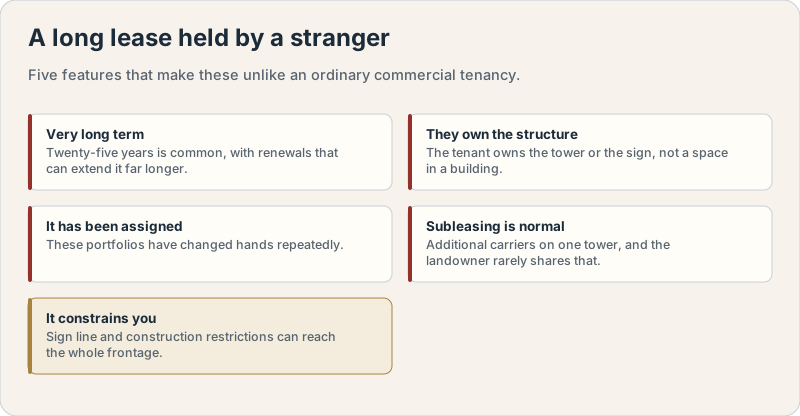
These leases also behave differently from ordinary commercial tenancies. The tenant owns the structure rather than occupying a building, the rent is small relative to the value of the site to the tenant, and the industry that holds them has consolidated heavily, so the party named in the original document is frequently not the party you will deal with.
What the Recorded Documents Show
The lease itself is rarely recorded in full. What reaches the record is usually a memorandum naming the parties, the premises and the term, filed to give notice without publishing the rent. That memorandum establishes that the interest exists and roughly how long it runs, and very little else.
Several related instruments are worth searching for separately, because each is recorded and indexed on its own.
- Assignments. Tower leases in particular have moved repeatedly as portfolios changed hands.
- Easements for access and utilities. A tower is useless without a road to it and power running to it, and those are frequently separate grants crossing the rest of the parcel.
- Easement purchases or lease buyouts. Aggregators buy the rent stream, sometimes as an easement in perpetuity rather than a lease, which converts a terminable interest into a permanent one.
- Subordination or nondisturbance agreements with an existing lender.
What the Lease Itself Decides
Everything that matters commercially is in the unrecorded document, and a buyer or lender should ask for it early rather than relying on the memorandum.
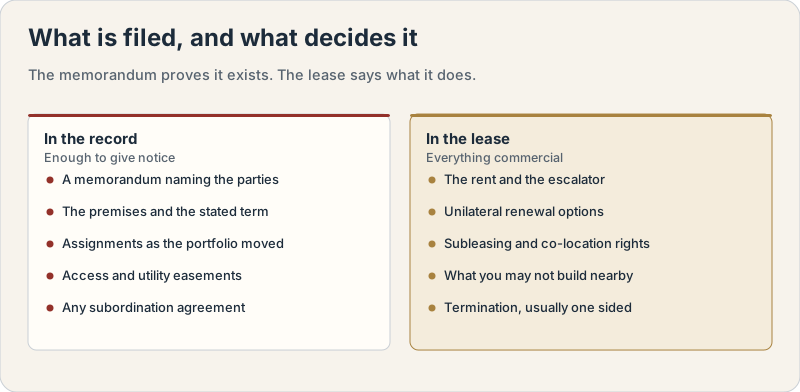
The term and the renewal structure, since many of these give the tenant unilateral renewal options that effectively make the arrangement permanent at the tenant's election. The rent and any escalator. Whether the tenant may sublease or license space on the structure to additional carriers, which is normal and means the site generates revenue the landowner does not share. Restrictions on what the landowner may build nearby, which on a billboard lease commonly includes a prohibition on blocking the sign line and can constrain the entire frontage.
And the termination provisions, which are usually one sided. Many of these leases allow the tenant to walk on short notice and give the landowner no equivalent right.
Who Actually Holds It Now
Tracing the current holder is ordinary chain work and it is the step most often skipped. The original lease may name a local operator that was acquired three times over, and the assignments may or may not all have been recorded. Where an aggregator bought the rent stream, the landowner's counterparty for rent and the tenant on the ground can be two different companies.
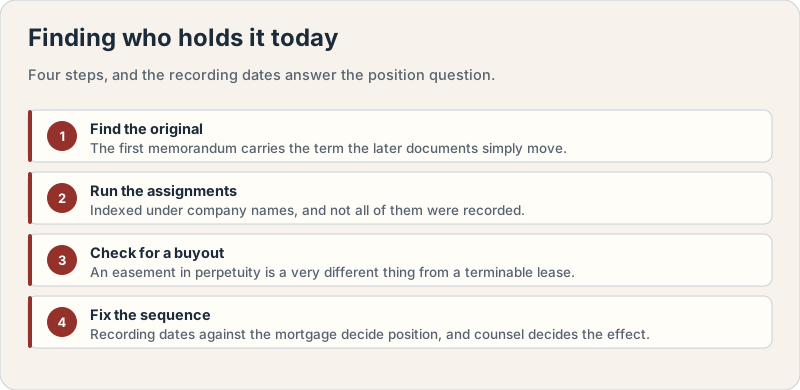
For a lender the practical question is position. A lease recorded before the mortgage may outrank it, a lease recorded after it is generally junior, and a nondisturbance agreement is what reconciles the two. That sequence is established from recording dates, which is exactly what a search produces. Whether it has the effect people assume is a legal question for counsel.
What to Order
Give us the address or parcel identifier, the landowner's name, and the name of the tower or outdoor advertising company if you know it. Ask for a search reaching back far enough to find the original lease rather than only the most recent assignment, because the terms live in the first document and the later ones simply move it.
Then get the lease and every amendment from the seller. Where the site is part of a larger commercial property, a commercial property search is the right baseline and the lease work sits inside it. Where the structure sits on a rooftop, confirm which parcel the building occupies before ordering.
A title search reports what was recorded and found in the indexes reviewed, as of the day the work was done. It does not produce the unrecorded lease, establish the rent, or determine who is entitled to payments today. See all search products, or tell us what is on the property and we will scope it before anything is ordered.
Order a certified title search today.
Certified abstractors, county-verified records, and clear turnaround times — nationwide.