TitleSearch.com Records
Deed Retrieval
On this page
Why the Copy You Have May Not Be Enough
Most people asking for a deed already have something. A scan the closing attorney emailed years ago, a photograph taken at a kitchen table, a printout from a county website. Any of those may be perfectly accurate, and none of them may be acceptable to the person now asking for it.
The reason is that three different things get called a copy, and they are not interchangeable. Knowing which one is needed before ordering saves a second order later, which is the single most common avoidable delay in this work.
Three Kinds of Copy
A plain copy is an image of the recorded instrument. It shows you what the document says, including the recording stamp, the book and page, and any marginal notations the clerk added. For reading and understanding, it is entirely sufficient.
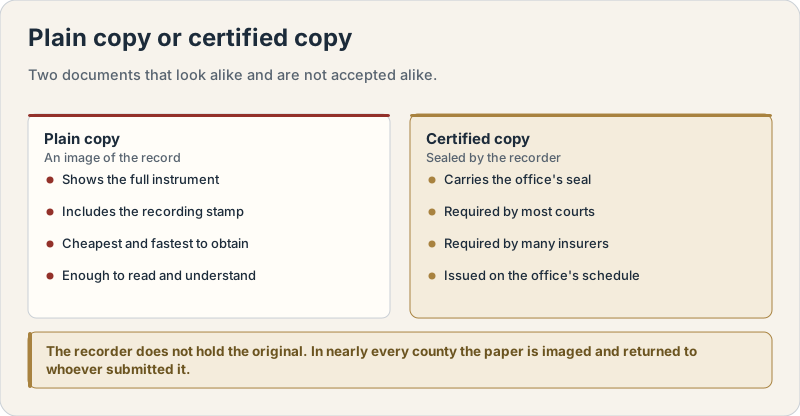
A certified copy carries the recorder's seal and a statement that it is a true copy of what that office holds. Courts, title insurers, foreign authorities and many lenders require this, and no amount of clarity in a plain scan substitutes for the seal.
An original is not something the recorder holds. In almost every American county the office records the instrument, images it, and returns the physical paper to whoever submitted it. If the original matters, the question is who got it back in 1974, and that is usually unanswerable.
The practical rule is simple. If a court or an insurer will rely on the document, order certified. If somebody needs to read it, plain is faster and cheaper.
Where Deeds Actually Live
Deeds are recorded at the county level, in an office called the recorder, the county clerk, the register of deeds or the land records division depending on the state. There is no national registry, and there is no state registry in most states. The instrument is in the county where the land sits, and nowhere else.
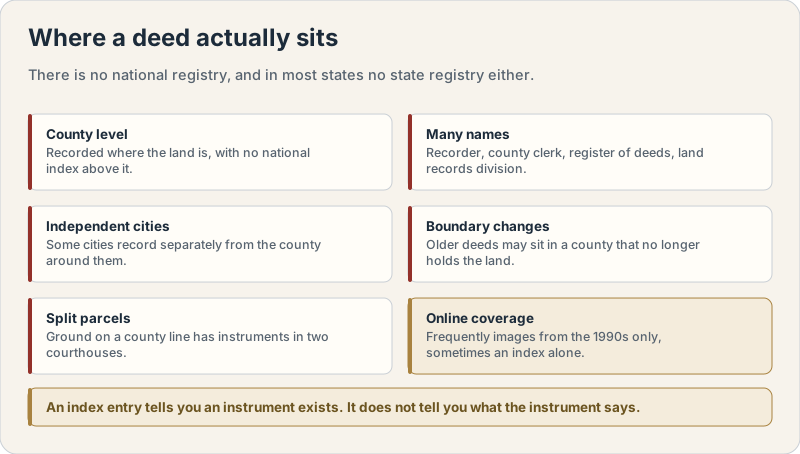
That produces the complications people run into. A property that changed county lines after a boundary adjustment may have its older deeds filed in a county that no longer contains the land. An independent city that records separately from the county around it is a different office entirely. And a parcel straddling a county line has its instruments split between two courthouses, both of which have to be searched.
Online availability varies enormously and it is worth being blunt about the limits. Many counties publish images going back to the 1980s or 1990s and index only from a similar date. Some publish an index with no images, which tells you an instrument exists and not what it says. A meaningful number publish nothing at all, and the only way to obtain the document is for somebody to walk into the building. That is the same local variation that shapes every chain of title search.
What Slows a Retrieval Down
Retrieval is usually quick, and when it is not, the cause is almost always one of four things.
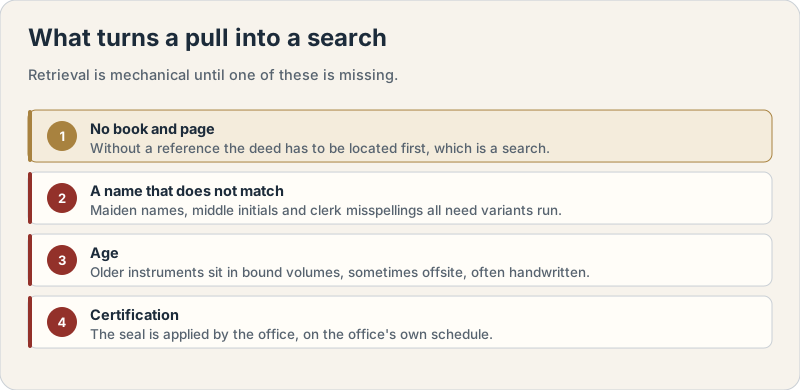
- An unknown book and page. Given a book and page reference, pulling the document is mechanical. Without one, the deed has to be located first, which is a search rather than a retrieval.
- A name that does not match. Indexes are built on names. A grantor recorded under a maiden name, a middle initial that comes and goes, or a misspelling entered by a clerk in 1962 all require variants to be run.
- Age. Older instruments sit in bound volumes, sometimes offsite, and frequently in handwriting. Retrieval is still routine and the timeline is not the same as pulling a 2019 deed from a screen.
- Certification. The seal is applied by the office, on the office's schedule, and that step cannot be compressed by anyone outside it.
What to Order
Give us the county and the state, the property address or the parcel identifier, and the names of the parties if you know them. If you have a book and page reference from a prior report or a title commitment, send that too, because it turns a search into a direct pull.
Say what the document is for. That single sentence decides whether you need plain or certified, whether one deed is enough or the whole chain is wanted, and whether related instruments such as the mortgage, its release or a subsequent correction deed should come with it. A deed retrieved without the correction deed that fixed it is a document that will mislead the person relying on it.
Where the deed turns out to be one link in a longer question, a chain of title search is usually the better order, and we will say so rather than sending a single document that does not answer what was actually asked.
See all search products or order a document retrieval. If you are not sure which copy you need, tell us who is asking for it and we will tell you what to order.
Order a certified title search today.
Certified abstractors, county-verified records, and clear turnaround times — nationwide.