TitleSearch.com Records
Severed Mineral Rights
On this page
One Piece of Ground, Two Estates
A deed usually reads as though it conveys everything from the sky to the center of the earth. Across much of the country it does not, because the mineral estate was separated from the surface long before the current owner arrived, and that separation is permanent unless somebody deliberately puts it back together.
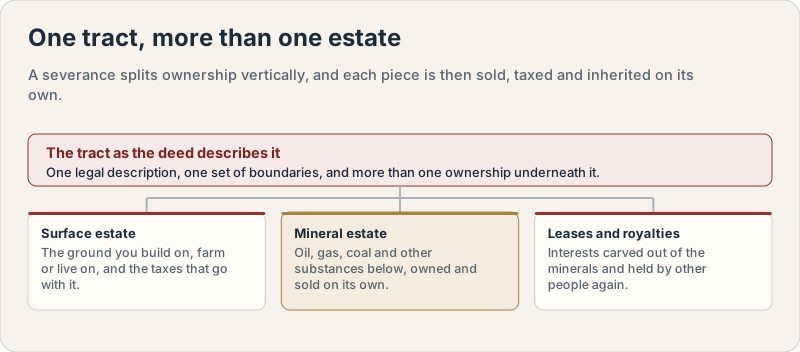
Once it has happened the tract carries two ownerships at once. The surface estate is what people picture as the property, the ground you build on, farm or live on. The mineral estate is the right to oil, gas, coal and other substances beneath it, and it is bought, sold, leased, mortgaged, taxed and inherited entirely independently of the surface.
Neither owner needs the other's permission to sell. That is how somebody can hold a warranty deed, pay the taxes for thirty years, and own nothing below the topsoil.
How the Minerals Leave the Land
Severance is ordinary rather than exotic, and it happens in a small number of ways that a search is built to find.
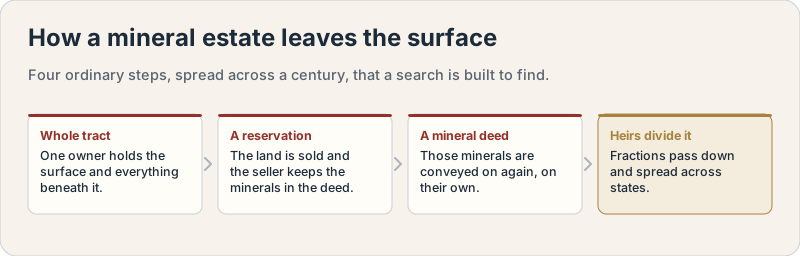
The most common is a reservation. An owner sells the land and keeps the minerals using a clause inside the deed itself, so there is no separate mineral instrument to look for and the severance is buried in the conveyance. The next is a mineral deed, which conveys the minerals to somebody else and leaves the surface where it was.
After that the interest behaves like any other property. It is sold on, divided among heirs, and divided again in the next generation, which is how one tract ends up with dozens of fractional owners across several states. Tax sales, foreclosures and corporate dissolutions move interests too.
Because the first severance is frequently the oldest document that matters, a mineral search generally has to run deeper than a search built to confirm current ownership. A twenty year look at a tract severed in 1917 finds nothing and proves nothing.
Why the Mineral Owner Can Reach the Surface
This is the part that surprises people, and it is the practical reason to run the search before a purchase rather than after one. In most states the mineral estate is dominant. The owner of a right that sits a mile underground needs some way to get to it, so the law implies a right of reasonable surface access to develop what they own. A surface owner who bought a quiet piece of land can find survey crews, an access road and a drilling pad arriving, with no obligation on anybody's part to have asked first.
What counts as reasonable varies by state, and many states have accommodation doctrines, surface damage statutes or notice requirements that soften it. Some owners negotiate a surface use agreement setting out where equipment may go and what is paid for the disturbance. Whether any of it applies to a given tract is a question for counsel rather than a finding an abstractor can make.
Recorded surface rights of other kinds sit alongside this one. Our guide to easement and right of way searches covers those.
Leases, Royalties and the Interests Carved Out of Them
Mineral ownership is rarely one undivided thing. Several distinct interests can be carved out of the same estate, held by different people, and recorded years apart.
The oil and gas lease
A lease gives an operator the right to explore and produce for a term, in exchange for a bonus paid up front and a royalty on what comes out. It is a conveyance rather than a rental, and it is recorded, frequently as a memorandum that states far less than the lease itself does.
Royalty interests
A royalty is a share of production free of the cost of getting it out of the ground. It can be reserved when minerals are sold, or conveyed on its own, which is how somebody can hold a royalty in a tract they have no other connection to.
The executive right
The power to sign a lease can be separated from ownership of the minerals. A person may own a fractional interest, have no say in whether it is leased, and take a share of a royalty set by a deal they had no part in.
What the Record Cannot Settle
A mineral search reports what was recorded and indexed in the county over the term searched, and it is worth being exact about where that stops.
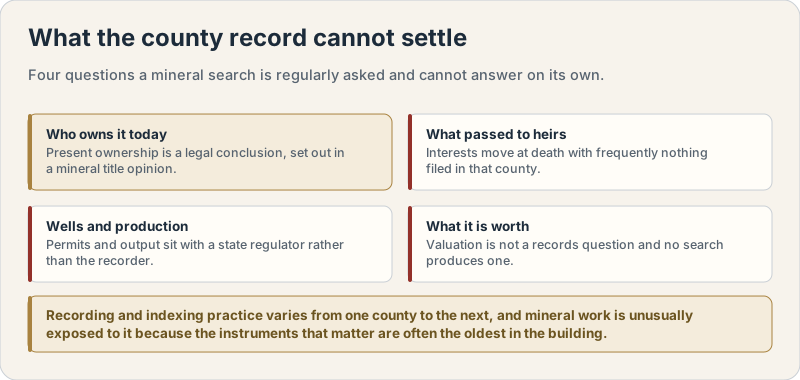
The largest limit is present ownership. Mineral interests pass at death, and in a great many cases nothing is filed in the county where the land sits, because the heirs and the estate were elsewhere. The last grantee named in the record is the last person the record knows about, which is not the same as the person who owns the interest today. Establishing that is a mineral title opinion, written by an attorney working from the abstract, and it is a legal conclusion rather than a search result.
The record also says nothing about wells, permits or production, which sit with a state oil and gas regulator rather than with the recorder. It does not value an interest. And it cannot confirm that an interest is unleased, because a lease may have expired by its own terms with no release ever filed.
Recording and indexing practice varies from one county to the next, and mineral work is unusually exposed to it, because the instruments that matter are often the oldest in the building.
What to Order
For most properties the useful scope is a mineral rights search run deep enough to reach the severance, which on older ground means a longer term rather than a shorter one. Where the real question is the ownership sequence, a chain of title search may be the better order and we will say so. Compare the options on the title search products page, or request a custom quote for acreage spanning several tracts or counties.
Send the legal description rather than the street address where you have one, along with the county and the state. Say what the search is for, because a surface owner who has just had a leasing letter, an heir tracing a fractional interest, and an operator building a chain for a unit need different depth on the same ground.
Contact us with the description and the county and we will tell you what a search of that scope would and would not cover before anything is ordered. Where this work runs continuously rather than one tract at a time, see how we support oil, gas and mineral clients.
Order a certified title search today.
Certified abstractors, county-verified records, and clear turnaround times — nationwide.