TitleSearch.com Records
Easement Searches
On this page
Somebody Else's Right Over Your Land
An easement is a right to use land that belongs to somebody else. The owner keeps the land. Another party holds a defined right to cross it, run a line beneath it, drain water over it, or keep part of it clear of buildings. The right attaches to the ground rather than to the person who agreed to it, which is why it survives a sale and binds a buyer who never read it.
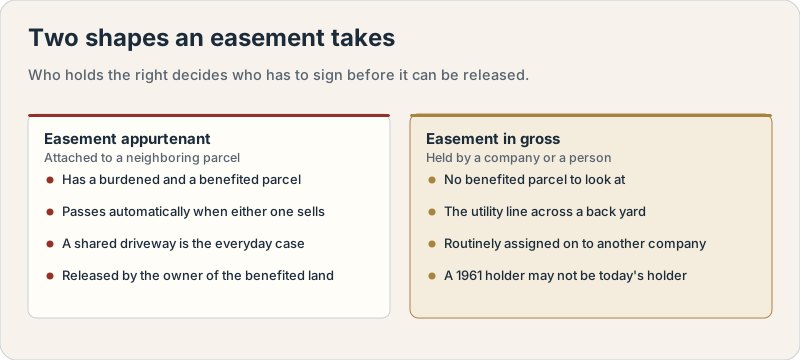
Easements come in two shapes. An easement appurtenant benefits a neighboring parcel, so there is a burdened property and a benefited property, and both rights travel with their land when either is sold. A shared driveway is the everyday example.
An easement in gross belongs to a person or a company rather than to a parcel. The utility line crossing a back yard is the common one, and there is no benefited property to look at because the benefit belongs to the utility itself. Easements in gross held by companies are routinely assigned, so the holder named in a 1961 instrument may not be the entity that shows up today.
Both kinds are recorded the same way and found the same way. The difference matters when somebody needs the right released, because the release has to come from whoever holds it now.
The Kinds That Turn Up in the Record
Most recorded easements fall into a handful of familiar patterns, and knowing which one you are looking at tells you most of what you need to know about how heavily it constrains the property.
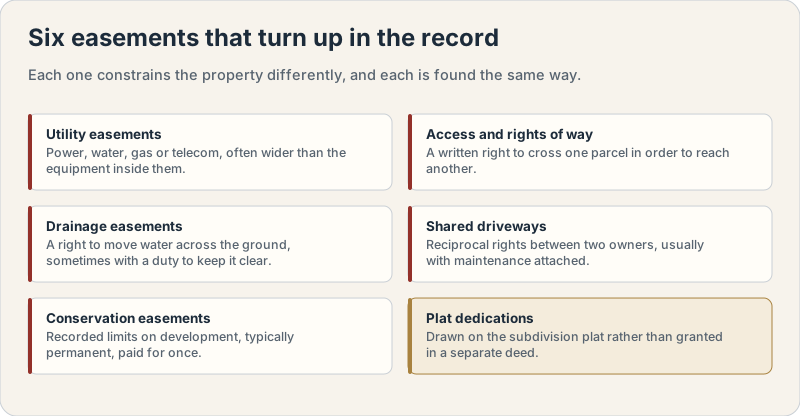
- Utility easements. Granted to a power, water, gas or telecom provider, often along a lot line, and frequently wider than the equipment sitting inside them. Access and utility grants serving a tower or billboard lease are a common variant.
- Access and rights of way. A written right to cross one parcel to reach another, which is what makes a back lot usable rather than landlocked on paper.
- Drainage easements. A right to move water across the ground, sometimes with a duty on the owner to leave the channel clear.
- Shared driveways and party walls. Reciprocal rights between two owners, usually with maintenance obligations attached.
- Conservation easements. Recorded limits on development, typically permanent, and typically paid for once to an owner who has since moved on.
- Plat dedications. Easements drawn on the subdivision plat rather than granted in a separate instrument, which is why the plat has to be pulled rather than assumed.
A recorded lease, a covenant or a mineral reservation can burden a parcel in a similar way without being an easement at all. Our guide to severed mineral rights covers the one that catches buyers out most often.
How Far Back the Search Runs
Easements do not expire because they are old. A right of way granted in 1948 is as enforceable today as one granted last year unless something was recorded to end it, so the term you search is really a decision about how much of the property's history you are willing to leave unexamined.
A shorter term
Twenty years catches anything granted in the modern era of the property, and on a lot platted recently that may be the whole story.
A longer term
Thirty and fifty year searches reach into the period when utility corridors, rail rights of way and farm access were being laid out. On older ground and on acreage, that is usually where the burdens are.
A custom term
Where one event matters, such as a subdivision, a road dedication or a utility's arrival in the area, the search can be run to that point instead. Tell us the date and why it matters and the scope follows from it.
Whichever term you pick, the findings come back in chronological order, so you can see the sequence rights were granted in rather than a list with no shape to it.
What a Search Will Not Find
This is the part worth being blunt about, because an easement report that comes back with nothing on it is easy to misread.
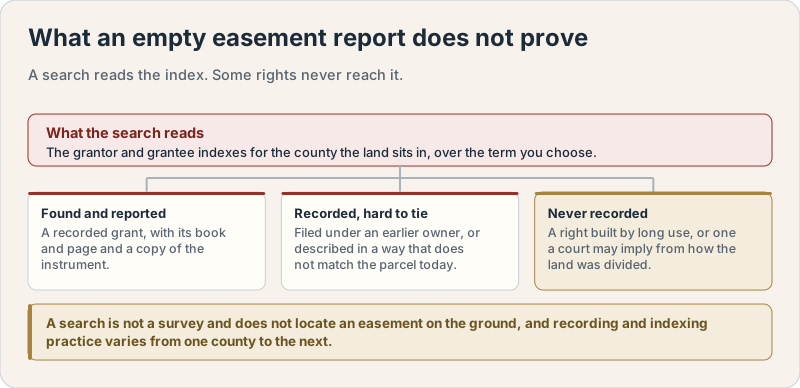
Some easements are created without any instrument being filed at all. A prescriptive easement can arise from long, open and uninterrupted use of somebody else's land on terms the state sets. An easement by necessity can be implied by a court where a parcel was split in a way that left one piece with no way out, and an easement implied from prior use works similarly. None of those has to appear in the county index, and a search cannot report what was never recorded.
Indexing is the second limit. An easement recorded under a prior owner's name, or described by a legal description that does not tie cleanly to the parcel as it exists now, can sit in the record and still be hard to connect. Recording and indexing practice varies from one county to the next, so what a thorough search looks like in one place is not what it looks like in the next.
And a search is not a survey. It reports the written right and its terms. It does not stake the corridor on the ground, confirm the pipe is inside the strip it was granted for, or say whether the new shed sits in it. A surveyor settles that, and whether a particular use exceeds what was granted is a question for a lawyer rather than for an abstractor.
What to Order
For most properties the useful scope is an easement search over a term long enough to reach the era the burdens were created in, run alongside whatever ownership search the transaction already needs. Compare the options on the title search products page, or request a custom quote for acreage, for several parcels, or for a term that does not fit the standard periods.
Send the address, the county and the parcel identifier if you have one, along with the plat or a prior title report if either exists. Say what you are trying to establish, because a buyer asking whether the land can legally be reached, a utility confirming a corridor, and an owner arguing with a neighbor about a driveway all need different scopes on the same parcel.
Contact us with the property and the question and we will tell you what a search of that scope would and would not cover before anything is ordered.
Order a certified title search today.
Certified abstractors, county-verified records, and clear turnaround times — nationwide.