TitleSearch.com Records
Reverse Mortgage Title Searches
On this page
Why the Title Standard Is Stricter Here
A reverse mortgage is the only common residential loan where the balance grows instead of shrinking and nothing is repaid until the borrower leaves the home. That single difference drives everything about how the title is examined.

The lender is taking a lien that has to stay in first position for perhaps twenty years, against a property it will not see again until the loan becomes due, and in the case of a federally insured home equity conversion mortgage there is a second lien in favor of the government behind it. A defect that a purchase lender might live with, because the loan amortizes and the borrower is making payments, is not acceptable where the principal only climbs.
The practical result is that the search has to be clean rather than merely adequate, and that the things which usually get cleaned up at closing have to be identified early enough to actually clean up.
Everyone on Title Has to Be on the Loan
This is the requirement that derails the most applications, and it is a records question before it is a lending question. Every person holding an interest in the property generally has to be a party, and every one of them has to meet the age requirement.
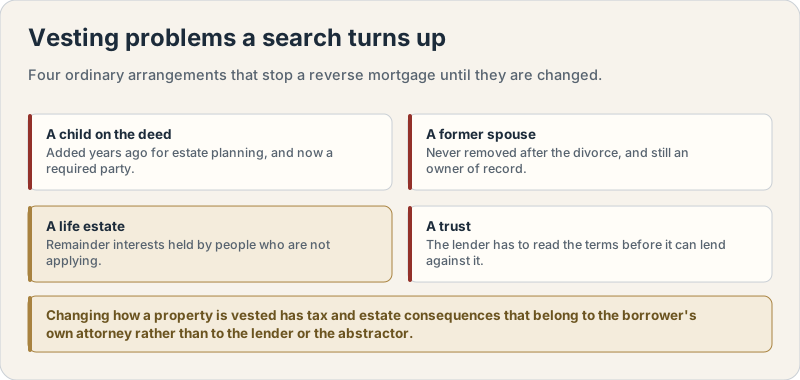
The situations that surface in a search are predictable once you know to look. A child added to the deed years ago for estate planning reasons. A former spouse never removed after a divorce. A life estate with remainder interests held by three siblings. A property conveyed into a trust whose terms the lender will have to read. Any of those means the vesting has to change before the loan can close, and changing vesting has consequences of its own that belong to the borrower's own attorney rather than to the lender.
Non-borrowing spouses are their own category. Federal rules give certain spouses who are not on the loan the ability to remain in the home after the borrower dies, and establishing who that is starts with what the deed and the marital history show. Our note on inherited property searches covers the adjacent problem of interests that passed with nothing recorded locally.
What Has to Be Cleared Before Closing
A reverse mortgage requires the existing mortgage to be paid off from the proceeds, which is straightforward. What is less straightforward is everything else the search turns up.
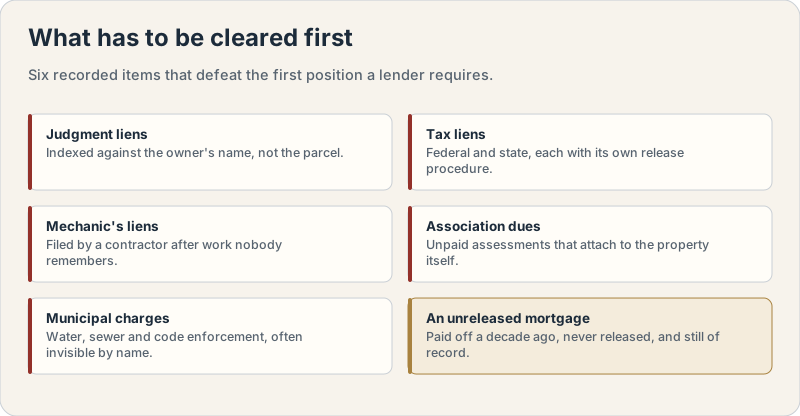
Judgment liens, federal and state tax liens, mechanic's liens, unpaid homeowner association assessments, code enforcement fines, and utility charges all have to be addressed, because any of them sitting ahead of or alongside the new lien defeats the first position the lender requires. A lien, UCC and HOA search is the part of the work that finds them.
Two further items are worth naming because they are easy to miss. Unreleased mortgages from a loan paid off a decade ago are extremely common, and clearing one means tracking down a lender that may have been acquired twice since. Solar panel financing recorded as a fixture filing or as an assessment on the tax bill is the newer version of the same problem, and it is not always visible from the loan file.
Any of these can be resolved. The point of searching early is that resolving them takes weeks, and a borrower who has already made plans around a closing date does not have weeks.
What the Search Will Not Settle
A title search reports what was recorded and found in the indexes reviewed, over the term searched. It does not establish that the borrower qualifies, it does not value the property, and it does not decide whether a particular vesting change is a good idea, which is a question for the borrower's own counsel and tax adviser.
Recording and indexing practice also varies from one county to the next, so where an instrument sits is a local fact. Our search process page sets out what an abstractor does in the courthouse and what comes back in the report.
What the search does deliver is the list of everything that has to be handled, early enough to handle it. Full title search is usually the right term where the property has been in one family for a long time, and a title search can be ordered here or you can tell us the address and the situation and we will say which term fits before anything is ordered.
Order a certified title search today.
Certified abstractors, county-verified records, and clear turnaround times — nationwide.