TitleSearch.com Records
Campground and RV Park Searches
On this page
Find Out What Was Already Sold
The first question on a campground or an RV park is not the condition of the ground. It is whether pieces of it have already been conveyed to somebody else, because several different business models have been run on this kind of property and they leave very different records.
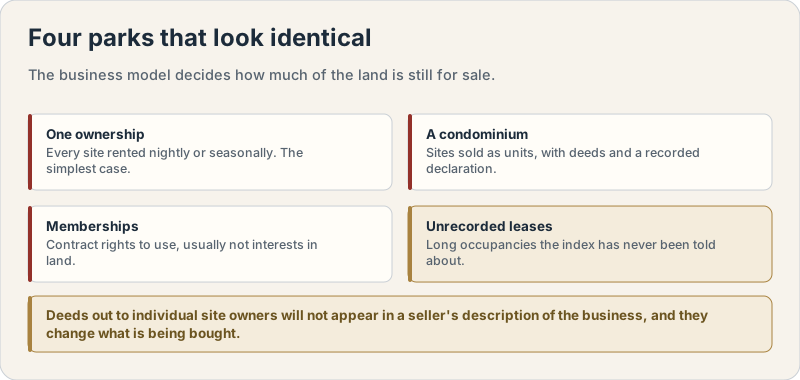
A park may be entirely in one ownership, with every site rented nightly or seasonally. It may be a condominium, where individual sites were sold as units with recorded deeds and a declaration governing the whole. It may run on memberships, which are usually contract rights rather than interests in land. Or sites may be held on long leases that were never recorded.
Those are four different purchases wearing the same gravel. Only the first and second are fully visible in a land records search, and establishing which one you are looking at is the whole of the early work.
Read the Declaration and the Plat
Where sites were sold, a declaration created them and a plat drew them. Both are recorded and both repay careful reading, because together they set out what a site owner actually got, what the common areas are, and who is responsible for the roads.
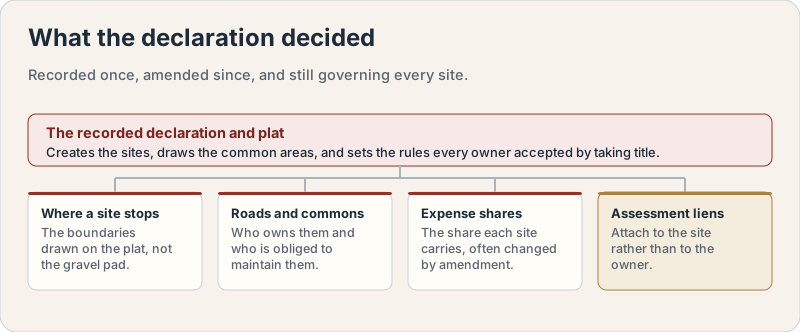
Amendments matter as much as the original. A declaration recorded in 1978 and amended four times since may have changed the allocation of expenses, the rules on rentals, or the number of sites. Our note on condominium and HOA searches covers how that structure is read.
Where an association exists, it will have its own lien rights for unpaid assessments, and those attach to the sites rather than to a person.
Water, Septic and Power Are the Real Asset
A park is a utility system with camping on top of it. Supply is frequently a well or a surface right rather than a municipal connection, and on a larger park the system may be regulated as a small public water system in its own right.
Wastewater is the constraint that usually caps the business. A septic system or a treatment lagoon is permitted for a stated capacity, and that number limits how many sites can operate regardless of how many are drawn on the plat. Permits sit with a state or county health authority rather than with the recorder, so a title search will not produce them.
What a search can produce is the recorded side of it. Easements for lines crossing neighboring land, shared well agreements, and any recorded agreement with an adjoining owner, which is the ground covered in our note on easement and right of way searches.
What to Search Before You Buy
Search every parcel in the property rather than the one with the office on it, because parks are routinely assembled and the entrance drive is often on a different tract. Run the chain far enough back to find the declaration if one exists, and search the current owner and any operating entity by name.
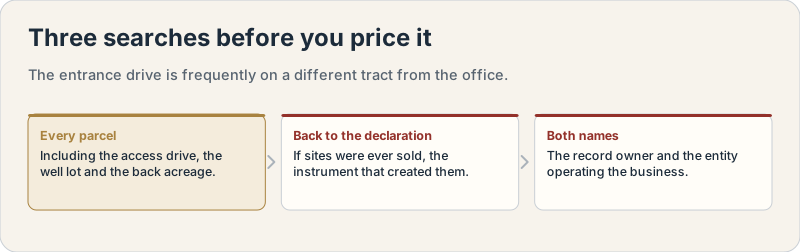
Then look specifically for deeds out. A handful of sites conveyed to individuals in the 1980s will not appear from the seller's description of the business, and they change what is being bought.
What the Record Cannot Settle
A search reports what was recorded and found in the indexes reviewed over the term searched. It cannot tell you the permitted capacity of the septic system, whether the water system is compliant, what the memberships entitle anybody to, or whether an unrecorded lease binds the land. Those answers come from the agencies, from the seller's contracts, and from counsel.
What it does establish is who owns what, before you price the whole. Order a title search with every parcel number, or send us the parcel list and we will tell you what a search of that scope would and would not cover.
Order a certified title search today.
Certified abstractors, county-verified records, and clear turnaround times — nationwide.