TitleSearch.com Records
Cemetery Searches
On this page
A Cemetery Is Not Ordinary Real Estate
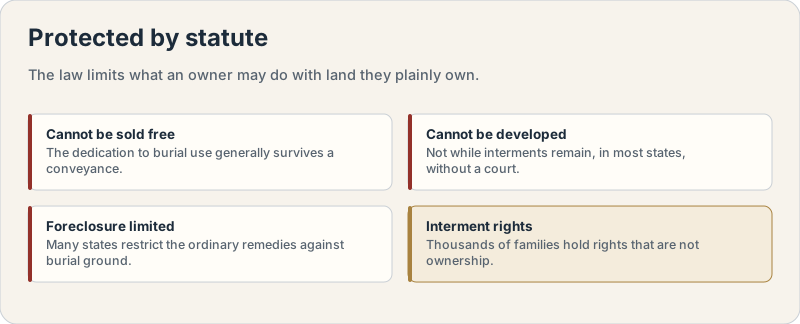
Burial ground is one of the few property types where the law limits what an owner may do with land they plainly own, and it does so in most states by statute rather than by anything recorded against the parcel.
A cemetery parcel is generally protected from being sold free of its use, from being developed while interments remain, and in many states from foreclosure in the ordinary way. Those protections exist because the people with the strongest interest in the land are not owners at all. They hold interment rights, and there may be several thousand of them.
A buyer approaching this as a commercial land purchase has misunderstood what is for sale. The real estate underneath is frequently the least valuable thing about the transaction.
What the Record Holds
A good deal, and the volume is the first surprise.
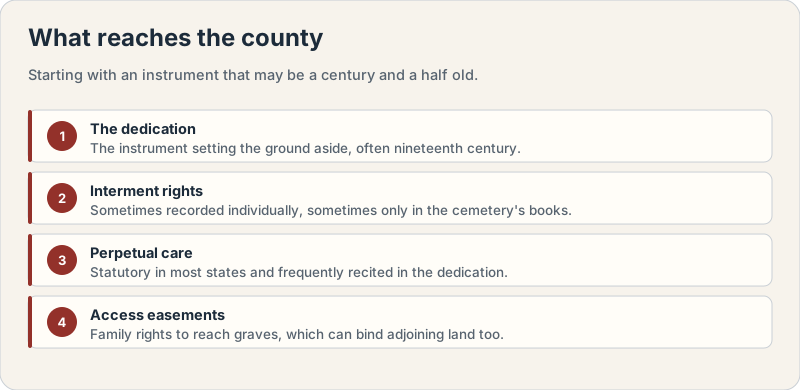
- The original dedication setting the land aside for burial, which in older cemeteries may be a nineteenth century instrument and is the root of every restriction that follows.
- Interment right conveyances, sometimes recorded individually and sometimes tracked only in the cemetery's own books. Where they are recorded, a single cemetery can account for thousands of index entries.
- Perpetual care fund obligations, which in most states are statutory and are frequently recited in the dedication or in a declaration.
- Access easements for families to reach graves, which can bind adjoining land as well as the cemetery parcel.
- Restrictions on remaining undeveloped sections, where a cemetery platted more ground than it has used.
The undeveloped sections are where most transactions concentrate, because unsold land within a dedicated cemetery is the part a buyer might actually be able to use. Whether it can be removed from dedication is a statutory question and usually a court one.
Funeral Homes Are a Different Transaction
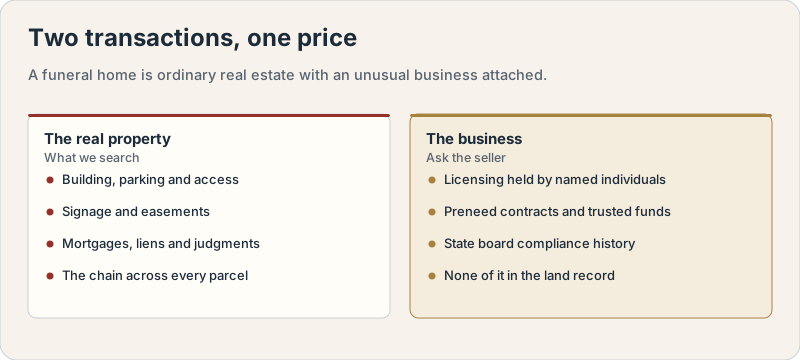
A funeral home is ordinary commercial real estate with an unusual business attached, and the two are frequently sold together as though they were one thing.
The real property searches normally. The building, any parking, signage and access easements, mortgages and liens all behave as they would on any commercial parcel. What does not transfer with the land is the licensing, which runs to the operator and to named licensed individuals rather than to the premises.
Preneed contracts are the item that decides these deals. Funds paid in advance for services not yet provided are held under state trusting requirements, they represent an obligation the buyer assumes, and they are not recorded anywhere. A buyer acquiring the business without establishing the preneed position has acquired an unquantified liability.
Where a funeral home operates alongside a cemetery under common ownership, the two parts need separate analysis even when one price covers both.
What Sits Outside the Record
Most of what determines whether a cemetery can be sold or developed.
State cemetery board registration and compliance history. The perpetual care fund balance and whether it has been maintained at the statutory level. The interment map showing which plots are sold, which are used and which remain available, which is the cemetery's own record and is frequently the only copy. Burial permits and the records of who is actually interred where.
On older and abandoned cemeteries, none of that may exist in usable form, and the surviving evidence is headstones and local memory. A records search will establish the chain of title accurately and tell you very little about what is in the ground.
Ordering the Search
Send us the address, the county, every parcel number, the cemetery or funeral home name including any former name, and the ownership entity with its variants. Tell us whether undeveloped sections are part of the transaction, because that changes what we look for in the dedication and the plats.
A full chain of title search reaching back to the original dedication is the right scope here rather than a current owner search, since the restrictions that govern are frequently the oldest instruments in the chain. A judgment and lien search against the operating entities belongs alongside it.
A title search reports what was recorded and found in the indexes reviewed, as of the day the work was done. It does not establish interment records, perpetual care fund status, licensing or preneed obligations. See all search products, or tell us the cemetery name and the county and we will scope it before anything is ordered.
Order a certified title search today.
Certified abstractors, county-verified records, and clear turnaround times — nationwide.