TitleSearch.com Records
Golf Course Searches
On this page
The Land Was Assembled, Not Bought
Almost no golf course sits on a single parcel. A typical eighteen-hole property is a dozen or more tracts acquired across decades, sometimes with a road vacated through the middle of it and a creek corridor that was never separately described. The legal description a seller hands you is frequently a composite somebody typed up for a prior closing rather than anything a surveyor certified.
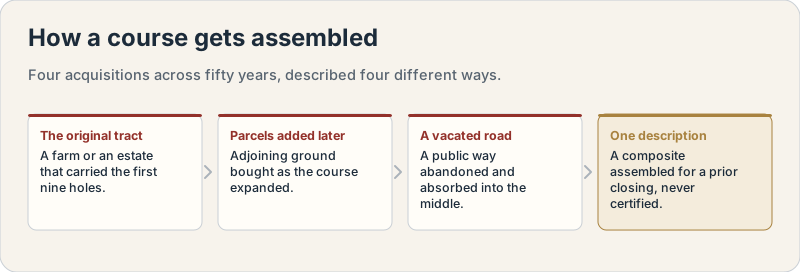
That matters because the perimeter of a golf course is almost entirely boundary with somebody else. Houses back onto it, a municipality owns a drainage way through it, and a utility crosses two fairways. Reconciling the tracts into one described property is the first real task, and it is the same work described in our note on lot line adjustments and boundaries.
Promises Made to the Houses Around It
The courses attached to residential developments carry a second layer the fairways do not show. When the subdivision was platted, the developer frequently recorded covenants that say something about the golf course, and those promises run with the land.
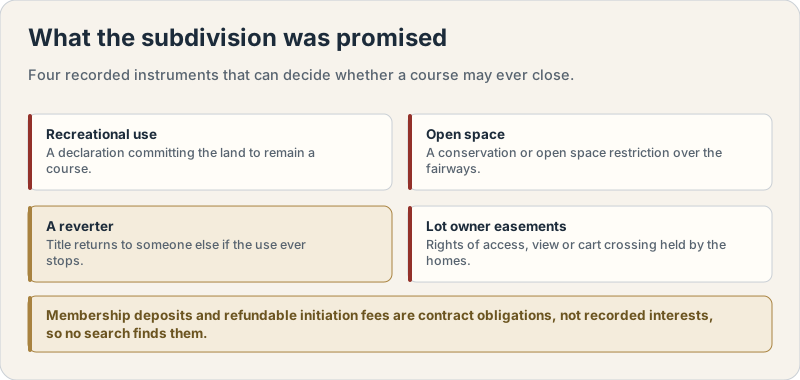
The recorded instruments to look for are a declaration committing the land to recreational use, an open space or conservation restriction, a reverter that returns the land to someone if the course closes, and easements giving lot owners rights of access, view, or cart crossing. Any of them can make redevelopment difficult or impossible, which is exactly the question a buyer paying for the land rather than the golf business is asking.
Membership deposits and refundable initiation fees are a separate matter. They are contract obligations rather than recorded interests in most cases, and a search will not find them. Ask for the membership documents directly.
Water Is Frequently the Real Asset
A course in the arid West can carry a water right worth more than the land under it, and that right does not necessarily travel with a deed. Irrigation wells, a surface right with a priority date, a contract with an irrigation district, or an agreement to take treated effluent from a municipality are all possible, and each sits in a different place.
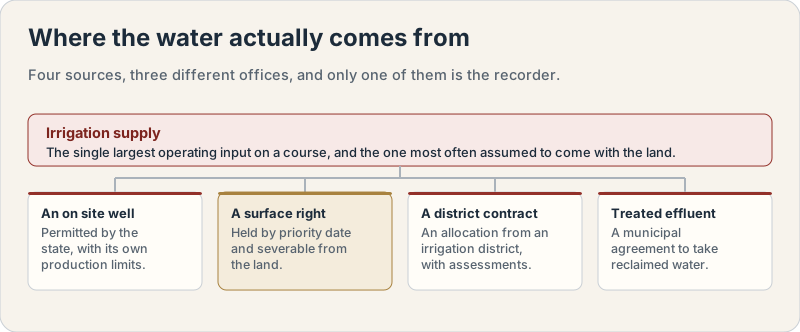
Some of it is recorded against the land. Much of it sits with a state engineer or a water resources department, and some of it is a contract held by the parties. Our note on water rights and well searches sets out how that split works and what a land records search can reach.
What to Search Before You Buy
Search every tax parcel in the property rather than the one with the clubhouse on it, because the parcel carrying the maintenance barn or the back nine is routinely held differently from the rest. Run the chain far enough back to reach the subdivision plat and the original declaration, since that is where the recreational use commitments were created.
Then pull the easements. Cart path crossings, access for member parking, utility and drainage runs, and any right of way to a neighboring development. A full title search is the term that reaches an assembled property of this kind, and on a course assembled over fifty years the shorter terms will not get to the instruments that govern it.
What the Record Cannot Settle
A search reports what was recorded and found in the indexes reviewed over the term searched. It does not tell you whether a use restriction can be released, what the membership obligations are, whether the water right is in good standing with the state, or what the zoning would allow if the course closed. Those answers come from counsel, from the state water agency, and from the planning department.
What a search does deliver is the recorded picture of an assembled property, with the instruments attached. Order a title search with every parcel number and the subdivision name, or send us the parcel list and we will tell you what a search of that scope would and would not cover.
Order a certified title search today.
Certified abstractors, county-verified records, and clear turnaround times — nationwide.