TitleSearch.com Records
Lot Line Adjustments
On this page
What a Lot Line Adjustment Actually Is
Two neighboring owners agree to move the line between them. One buys twenty feet, or a strip is traded to square up a yard, or a driveway that has always crossed the line is finally brought inside it. The municipality approves the new configuration, deeds are exchanged, and the parcels are reconfigured without creating any new lot.
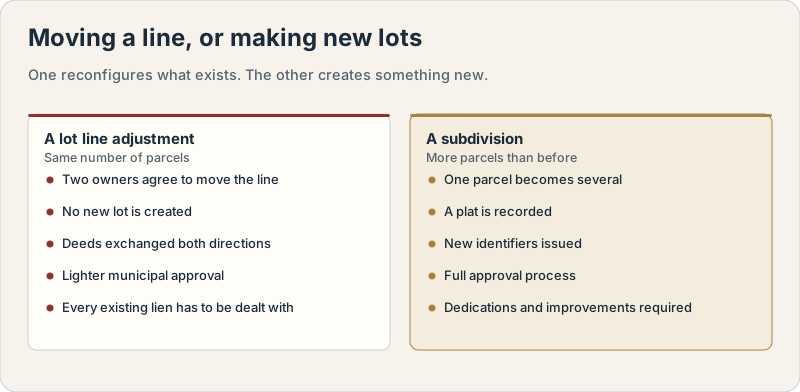
That last point is what distinguishes it from a subdivision, and it is why the process is comparatively light on the planning side. The title side is not light at all, because every interest recorded against either parcel now attaches to a differently shaped piece of ground.
What Moves With the Line
This is the part that surprises people, and it is the reason a lot line adjustment is a two-parcel title problem rather than a survey exercise with paperwork attached.
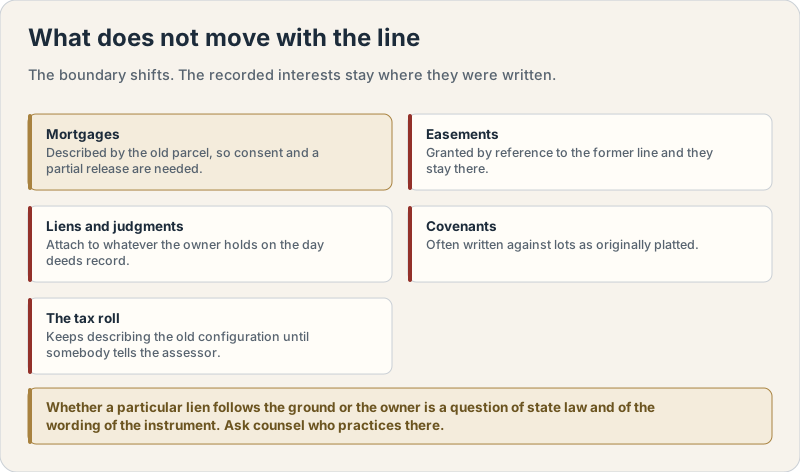
- Mortgages do not follow the intention. A lender holding a deed of trust on parcel A has a lien described by parcel A's legal description. Move the line and the lien still encumbers whatever that description covered. Lender consent and a partial release or a modification is the usual requirement, and obtaining it is the step that takes the longest.
- Easements stay where they were granted. A utility easement described by reference to the old boundary does not relocate because the boundary did. It may now cross what has become the neighbor's land.
- Judgment and tax liens attach to the owner's interest in whatever that owner holds, which changes on the day the deeds record.
- Covenants and restrictions imposed by a subdivision may apply to lots as originally platted, and a reconfigured lot can sit awkwardly against them.
What the Search Has to Cover
Both parcels, to the same depth, before anything is drafted. An adjustment is only as clean as the worse of the two chains, and the parcel nobody was worried about is where the problem usually is.
For each side that means the current vesting and the exact recorded description, every mortgage and deed of trust with its description, liens and judgments indexed against each owner, and every easement, covenant and plat restriction of record. It also means the earlier history of the strip being moved, because a narrow piece of ground that has been traded before may have its own small chain.
Where either owner is an entity or a trust, the names to run are the entity's, which is the point made in our note on entity owned property.
Where These Go Wrong
Four failures account for most of them.
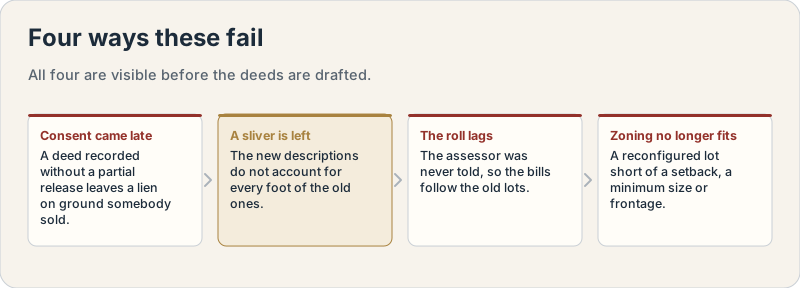
Lender consent obtained late, or not at all. A deed recorded without a partial release leaves a lien encumbering ground the borrower no longer owns and leaves the neighbor's new strip subject to somebody else's mortgage. Curing it afterward means going back to a lender who has no reason to prioritize it.
A description that does not close. The new descriptions have to account for every square foot of both original parcels between them. Where they do not, a sliver is left owned by nobody in particular, which is the gap problem that makes quiet title actions necessary years later.
The adjustment recorded but never mapped. The deeds are filed and the assessor is not notified, so the tax roll continues to describe the old configuration and the bills go to the wrong parties.
A new nonconformity. Reconfiguring the lots leaves one of them short of a setback, a minimum lot size or required frontage. That is a zoning question rather than a title question, and it is the one most likely to stop the approval.
What to Order
Give us both addresses or both parcel identifiers, the names of every owner on both sides, and a description of the strip being moved if one has been drafted. Say whether either parcel carries a mortgage, because that decides how early the lender conversation has to start.
A chain of title search on each parcel is the usual scope, rather than a current owner search, since the history of a traded strip is frequently older than a short term would reach. Where the parcels sit in a platted subdivision, the plat and any amendments belong in the order.
A title search reports what was recorded and found in the indexes reviewed, as of the day the work was done. It is not a survey and does not locate a boundary on the ground, it is not a zoning determination, and it is not a legal opinion about whether an adjustment is permissible. See all search products, or tell us what the two parcels are and we will scope it before anything is ordered.
Order a certified title search today.
Certified abstractors, county-verified records, and clear turnaround times — nationwide.