TitleSearch.com Records
Entity Owned Property
On this page
Who Actually Owns It
A deed naming Maple Ridge Holdings LLC tells you the property belongs to Maple Ridge Holdings LLC. It tells you nothing whatever about who owns Maple Ridge Holdings, who may sign for it, or whether it still exists. The recorder does not know any of that and has no reason to.
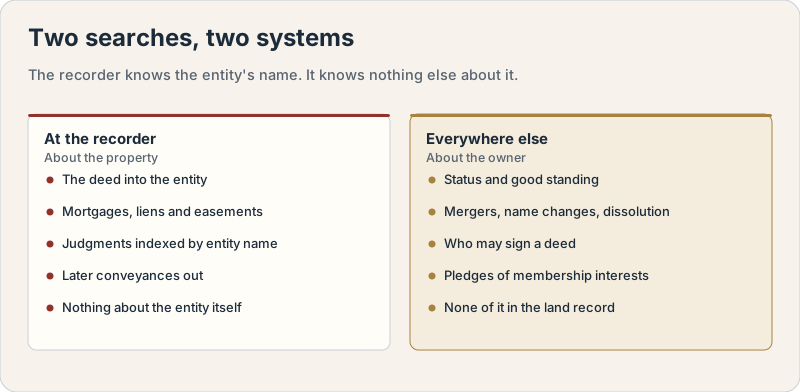
That gap is the whole subject. Entity and trust ownership is completely ordinary, most of it is done for perfectly sensible liability and estate reasons, and it splits the question into two searches in two different systems that do not talk to each other.
What the Land Record Shows About an Entity
Everything it shows about any owner, and nothing more. The deed conveying title to the entity, with its exact name as recorded. Mortgages, liens and easements against the property. Judgments indexed against the entity name. Later conveyances out.
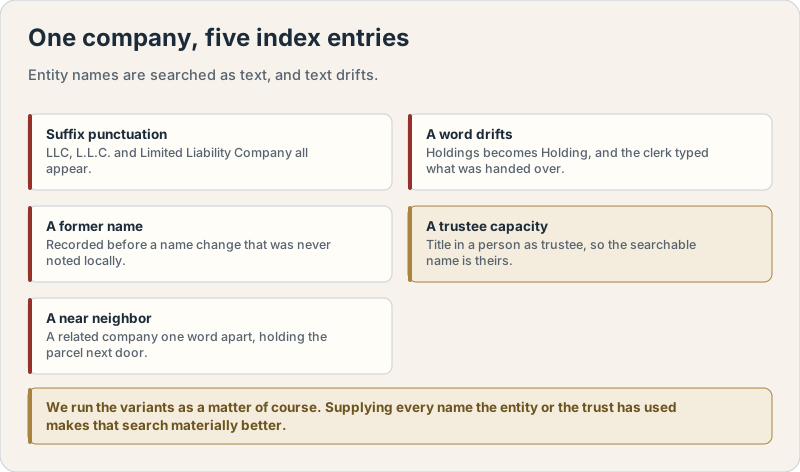
The exact name is worth dwelling on, because entity names are searched as text and text varies. Maple Ridge Holdings LLC, Maple Ridge Holdings, L.L.C., and Maple Ridge Holding LLC are three different index entries and possibly the same company. A judgment docketed under one variant will not surface in a search run against another, which is the entity version of the problem described in our note on the chain of title search.
Trusts add their own wrinkle. Many states record title in the trustee rather than in the trust, so the deed reads "Jane Doe, Trustee of the Doe Family Trust" and the searchable name is Jane Doe in a capacity. Where the trustee changes, the successor may or may not have recorded anything.
Where the Rest of the Answer Lives
Three other places, none of them at the recorder.
The secretary of state in the state of formation holds the entity's status, its formation date, its registered agent and any merger, name change or dissolution. That is where you learn the company was administratively dissolved in 2019 for an unfiled report, which is common, reversible in many states, and invisible in the land record.
The entity's own documents hold the authority question. An operating agreement, a partnership agreement or a trust instrument says who may sign a deed or a mortgage, and whether a sale needs consent from members or beneficiaries. Those are private documents obtained from the owner, not from any public index.
The UCC index holds security interests in the entity's personal property and, on some structures, in the membership interests themselves. A pledge of the LLC's membership interests is a way of encumbering the property economically without anything at all appearing in the county.
Common Problems in an Entity Chain
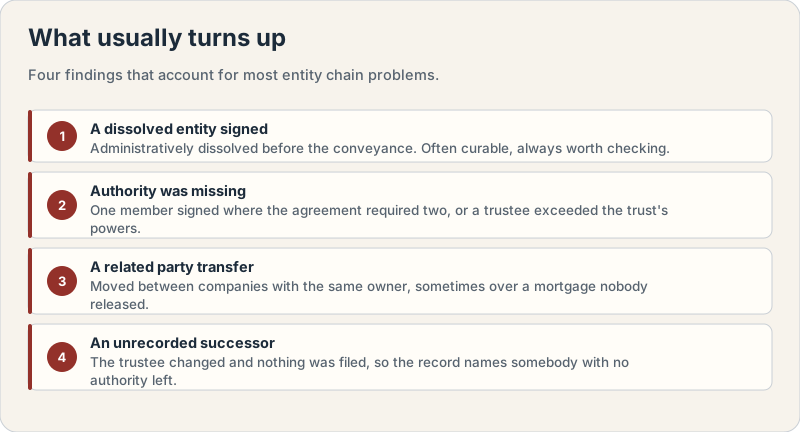
- A dissolved entity in the chain. The company was administratively dissolved before it signed the deed. Whether that affects the conveyance depends on state law, and it frequently does not, but it has to be looked at.
- A signature without authority. One member signed where the operating agreement required two, or a trustee acted outside the powers the trust instrument grants.
- A transfer between related entities. Property moved from an individual to an LLC, or between two companies with the same owner, sometimes with no consideration and sometimes with a mortgage that was never assumed or released.
- A trustee nobody recorded. The original trustee died or resigned, a successor took over, and nothing was filed, so the record still names somebody with no remaining authority.
Each of these is findable. None of them is findable from an index line, which is why the instruments come back attached.
What to Order
Give us the address or parcel identifier, the exact entity name as it appears on the deed, and any earlier names the entity or the trust has used. Tell us the state of formation if you know it, and say whether the file involves a sale, a loan or diligence, because it changes how far back the name searches run.
For most entity-held property a current owner search with judgment and lien searches against the entity name and its variants is the right scope, and where the property changed hands between related parties a chain of title search is better. Where the entity holds several properties, a portfolio search priced as volume work is usually the sensible route.
A title search reports what was recorded and found in the indexes reviewed, as of the day the work was done. It does not establish who owns or controls the entity, whether a signer had authority, or whether a transfer was proper. Those are answered from corporate filings and the entity's own documents, and the conclusions belong to counsel. The same authority questions arise in sharper form on a church or nonprofit property search, where a denominational body or a board may have to consent before anyone can sign. See all search products, or tell us who holds the deed and we will scope it before anything is ordered.
Order a certified title search today.
Certified abstractors, county-verified records, and clear turnaround times — nationwide.