TitleSearch.com Records
Portfolio Searches
On this page
One Property or Two Thousand
A single title search is a question with an answer. A portfolio search is an operational problem that happens to be made of title searches, and treating it as the first thing is why volume orders go wrong.
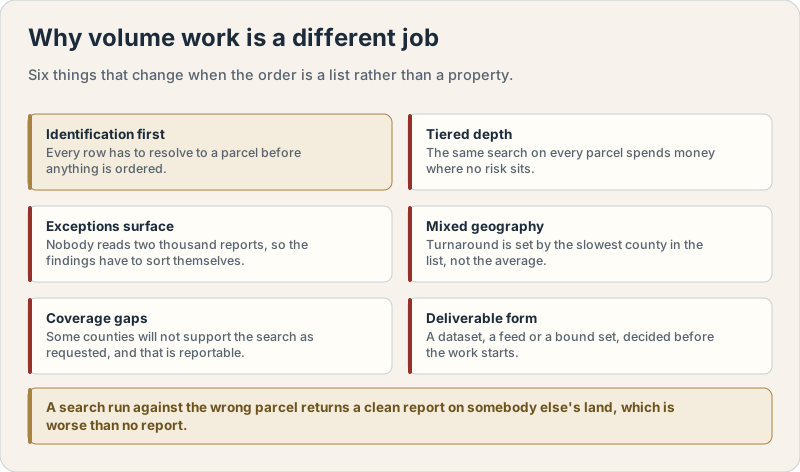
Three differences drive everything else. The parcels have to be identified before anything can be ordered, and on a real portfolio a meaningful share of the addresses will be wrong or ambiguous. The searches cannot all be the same depth, because paying for a fifty-year chain on every parcel is money spent where no risk exists. And nobody is going to read two thousand reports, so the output has to surface its own exceptions.
Getting the Parcels Right First
Identification is where portfolio work is won or lost, and it is consistently underestimated. A list of street addresses is not a list of parcels.
Addresses are assigned by municipalities for mail delivery. Parcels are defined by the county for taxation and by the deed for conveyance, and the three do not always agree. A single address can cover several parcels. A parcel can carry no address at all, which is normal for vacant land and for the strip of ground behind a building. Rural addressing changed wholesale in many counties when emergency services renumbering came through, so an address from an older file may not resolve to anything today.
The fix is to resolve every row to a parcel identifier before a single search is ordered, and to return the rows that will not resolve rather than guessing at them. A search run against the wrong parcel produces a clean report on somebody else's land, which is worse than no report because it carries confidence.
Tiering the Search by Risk
Once the parcels are fixed, the question is depth. Running the deepest available search on everything is defensible and expensive. Running the shallowest on everything is cheap and does not answer the question on the parcels that matter.
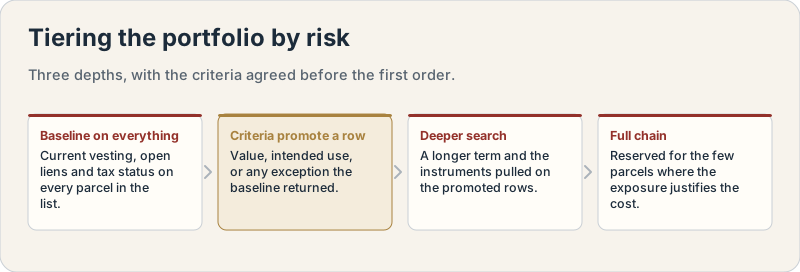
The workable pattern is three tiers. A baseline search on every parcel, establishing current vesting, open liens and tax status. A deeper search on parcels that the baseline flags, or that meet a risk criterion set in advance. And a full chain on the small number where the value, the intended use or the flagged exception justifies it.
What sets the criteria is the purpose. An acquisition due diligence exercise cares about anything that affects value or use. A lending portfolio cares about lien position above all. A tax or insurance review cares about assessment and ownership accuracy. Saying which one this is, before the order, changes what gets ordered on every row.
What Comes Back, and In What Form
For a portfolio, the deliverable is a dataset with documents attached rather than a stack of documents. That means a row per parcel with the findings in fields your own systems can read, the exceptions flagged so they sort to the top, and the underlying instruments available for the rows that need a human to look at them.
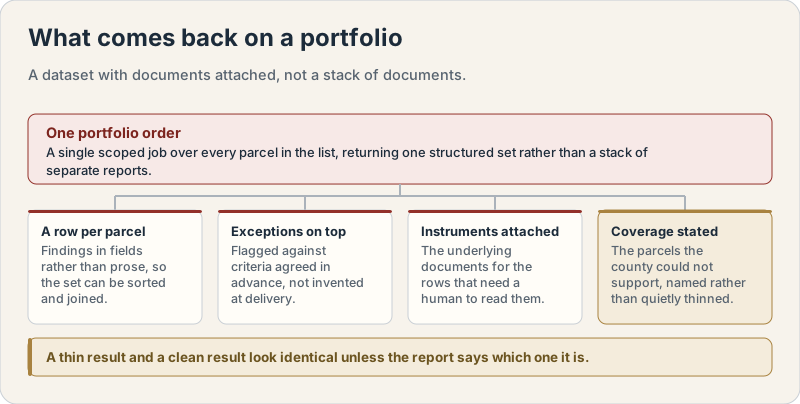
Two practical points follow. First, the summary has to be honest about coverage, naming the parcels where the county's records did not support the search as requested rather than quietly returning a thin result that looks the same as a clean one. Second, an exception report is only useful if it is built against criteria agreed in advance, so those get settled at scoping rather than afterward.
Format is a scoping question too. Some clients want a spreadsheet, some want a structured feed into an existing system, and some want a bound set of reports because a lender or a board will read them. All three are ordinary. Deciding which one, before the work starts, avoids rebuilding the deliverable at the end.
What to Order
Send the list in whatever form it exists, including the messy one. Addresses, parcel numbers, legal descriptions, a mix of all three, or an export from a system that was never designed to produce this. We would rather see it as it is than receive a tidied version with the ambiguities already guessed at.
Tell us the purpose, the deadline and the states involved. Turnaround on volume work is set by the slowest counties in the list rather than by the average, so knowing the geography early is what makes a realistic date possible. Where the portfolio includes commercial ground, a commercial property search is usually the right baseline tier rather than the residential one.
For enterprise clients running this regularly, the same work can be delivered through an ongoing arrangement rather than order by order. See corporate and enterprise services for how that is set up, or how the searches are delivered if the output needs to reach your systems directly.
See all search products, or send us the list and we will scope it and quote it before anything is ordered. Multi site operators frequently order this alongside a self storage facility search, where each location is usually several parcels rather than one.
Order a certified title search today.
Certified abstractors, county-verified records, and clear turnaround times — nationwide.