TitleSearch.com Records
Quiet Title Searches
On this page
What a Quiet Title Action Is For
A quiet title action asks a court to declare who owns a property and to extinguish the competing claims. It exists because the recording system produces questions it cannot answer. An old mortgage with no release, a deed from someone who may never have held title, an heir nobody can locate, a tax deed whose notice may have been defective. None of those can be fixed by recording something new, because the person who would have to sign is gone, unknown or unwilling.
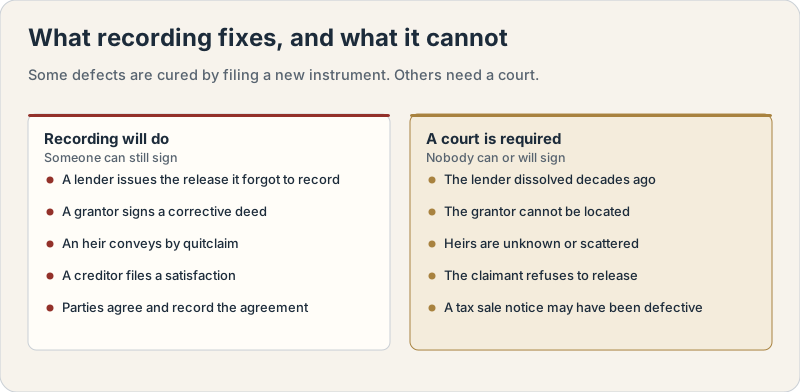
The remedy is a judgment, and a judgment binds only the people who were properly brought before the court. That single sentence is why a quiet title action is a records exercise before it is a litigation exercise. Everyone with a recorded interest has to be found, named and served, and finding them is the search.
Who Has to Be Named
The defendants in a quiet title case are not the people currently arguing about the property. They are everyone the record shows as holding an interest, however stale, however unlikely, and however inconvenient.
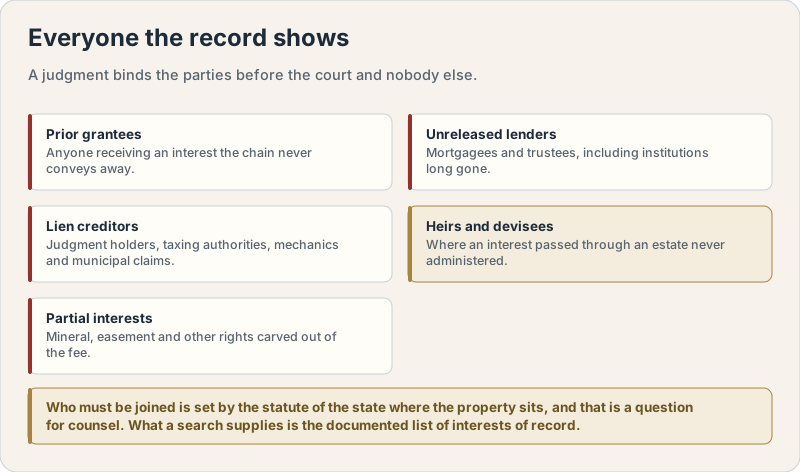
That list is longer than people expect. Every grantee in a deed the chain does not close out. Every mortgagee whose lien has no recorded release, including institutions that failed decades ago and whose successors have to be traced. Judgment creditors, tax authorities, lienholders of every description. Heirs and devisees where an interest passed through an estate. Holders of mineral, easement or other partial interests carved out somewhere back in the chain.
Missing one is the characteristic failure. The judgment is entered, the property is sold, and years later a party who was never served appears with a claim the decree did not touch, because a court cannot bind someone it never had before it.
What the Search Has to Establish
Three things, and they are cumulative. The chain of title read back far enough to show where the defect originated, which frequently means going well past the term a purchase search would use. The complete list of recorded interests outstanding against the property, each with the instrument that created it. And the last known identity and address of each named party, so service can be attempted and, where it fails, so the court can be shown that a diligent effort was made.
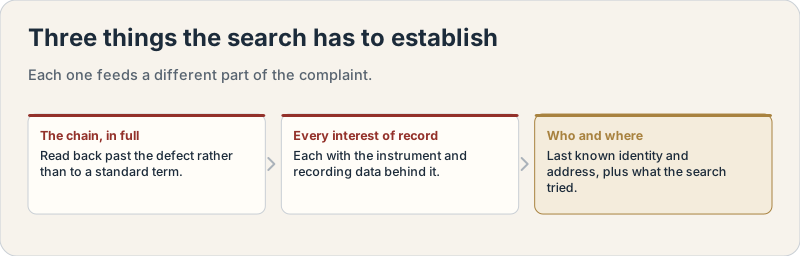
That last element is the one people underestimate. Service by publication is available in most states when a defendant cannot be located, but courts generally require a showing of diligent search first, and a thin effort is a visible weakness in the file. A records search documenting what was run and what was found is part of that showing.
Depth matters too. A chain of title search scoped to twenty years will not reach a 1948 reservation or a 1963 mortgage, and those are exactly the interests that make an action necessary. Scope the search to the defect rather than to a standard product.
Where These Actions Fail
Most of the ways a quiet title action goes wrong are records problems rather than legal ones.
- An interest outside the term searched. The search stopped at thirty years and the problem was recorded in 1951.
- A name variant nobody ran. An entity that merged, a married name, a misspelling entered by a clerk, a trustee holding under a name that does not resemble the beneficiary's.
- A wild deed. An instrument recorded outside the chain, indexed under a grantor who never held title, and therefore invisible to a search that follows the chain alone.
- Records in the wrong office. Judgments and probate matters sit with the court rather than the recorder, and a parcel on a county line has instruments in two courthouses.
- An unresolved heirship. An estate that was never administered leaves interests distributed by statute among people no index names.
None of these are exotic. Each of them is ordinary, and each of them is findable if the search was scoped to find it.
What to Order
Tell us what the defect is and how far back you think it reaches, and we will scope the term to it. On most quiet title work that means a full chain rather than a current owner search, together with a judgment and lien search against every name appearing in the chain, and copies of the instruments rather than a summary, because the complaint has to plead recording data.
Where the action follows an auction purchase, order before bidding rather than after, since what survives the sale decides how large the action will be. That is covered in the guidance on a tax deed and tax lien search. Where the property carries a severed interest, a severed mineral rights search is usually the right companion order.
We do not practice law and we do not decide who should be named. What we supply is the documented record the pleading is built from, and the trail showing what was searched. See all search products, or tell us what the title problem is and we will tell you what a search of that scope would cover before anything is ordered.
Order a certified title search today.
Certified abstractors, county-verified records, and clear turnaround times — nationwide.