TitleSearch.com Records
Tax Sale Title Searches
On this page
Two Different Things Are Sold at Two Different Sales
Counties recover delinquent property taxes in one of two broad ways, and buyers routinely confuse them because both are advertised as tax sales.
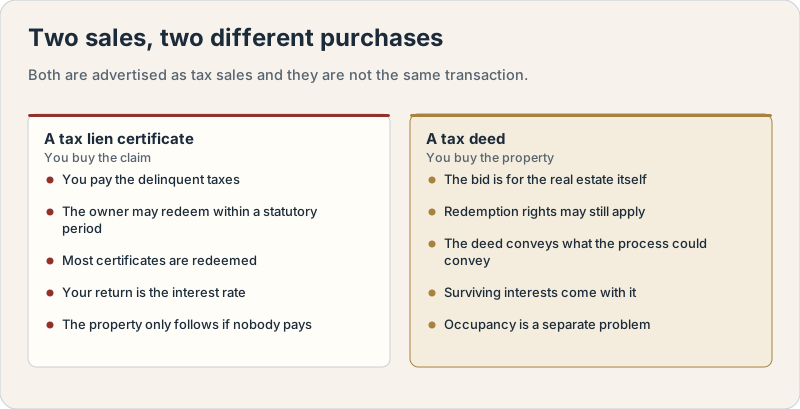
At a tax lien sale you are buying the county's claim, not the property. You pay the delinquent taxes, you receive a certificate, and the owner has a statutory period in which to redeem by repaying you with interest. Most certificates redeem. The return is the interest rate, and the property only comes into it if nobody pays.
At a tax deed sale you are buying the property itself, subject to whatever redemption rights that state still allows. The bid is for the real estate, and the deed you receive conveys whatever the process was able to convey, which is not always what the catalog implies.
Which system applies, how long the redemption period runs, and what has to happen before a deed issues are all matters of state statute, and they differ enormously. Nothing in this note substitutes for reading the law of the state you are bidding in, or for advice from counsel who practices there.
What a Tax Sale Wipes Out, and What Survives
The general principle is that a tax sale conducted properly extinguishes most private liens, because the tax claim outranks them. That is why the sales are attractive. The exceptions are where the money is lost.
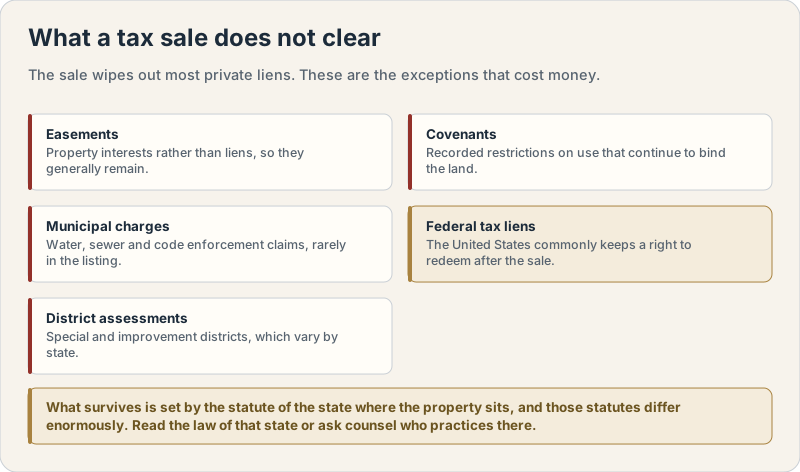
Easements and rights of way generally survive, because they are property interests rather than liens. Recorded covenants and restrictions survive. Municipal claims for water, sewer, and code enforcement frequently survive, and they are rarely visible in the advertised list. Federal tax liens are their own case, since the United States commonly retains a right to redeem for a defined period after the sale. Other governmental claims, assessments, and special district charges vary by state.
Occupancy is separate from title. A tax deed says nothing about who is living in the house, and removing an occupant is a legal process in its own right. Our note on foreclosure auctions covers the same dynamic at a different kind of sale.
Notice Is the Usual Ground for Attack
The most common way a tax title fails is not a lien that survived. It is a defect in the process that produced the deed.
Before a government can take property for unpaid taxes it has to make a reasonable effort to notify the people with an interest in it, and the courts have been willing to set sales aside where that effort was inadequate. A notice mailed to the taxed address and returned undelivered, with no further attempt made, is the textbook example. Heirs who never recorded anything, a mortgage holder indexed under a name that changed, a beneficiary of a life estate, and an owner who moved are all parties whose treatment during the notice process can be challenged afterward.
That is why buyers of tax deeds so often end up filing a quiet title action before they can sell or insure the property. Establishing who was entitled to notice is a records exercise, and it is the same chain work described in our note on the chain of title search.
What to Search Before You Bid
The advertised list gives a parcel number and an amount owed. It is not diligence.
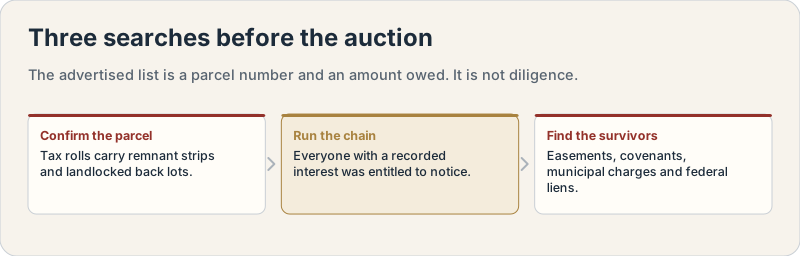
Start with the legal description and confirm the parcel is what you think it is, because tax rolls carry remnant strips, landlocked back lots, and slivers left over from road projects that nobody would knowingly buy. Then run the chain far enough back to identify every party with a recorded interest, since those are the people whose notice rights determine whether the deed holds. Then search for the survivors, meaning the easements, covenants, municipal charges, and federal liens that a sale does not clear. A full title search is the term that reaches all three, and on a portfolio of parcels a bulk and portfolio search is the practical way to do it at volume.
What the Record Cannot Settle
A search reports what was recorded and found in the indexes reviewed over the term searched. It cannot tell you whether notice was legally sufficient, whether a particular lien survived under that state's statute, or whether a quiet title action will succeed. Those are legal conclusions for counsel. It also cannot tell you the condition of the building or who is inside it.
What it can do is tell you what is on the parcel and who has an interest in it before your money is committed rather than after. Order a title search with the parcel number and the county, or send us the sale list and we will tell you what a search of that scope would and would not cover.
Order a certified title search today.
Certified abstractors, county-verified records, and clear turnaround times — nationwide.