TitleSearch.com Records
Water Rights Searches
On this page
Two Completely Different Systems
Whether water comes with a property depends first on which half of the country the property is in, and the two systems are not variations on a theme. They are opposites.
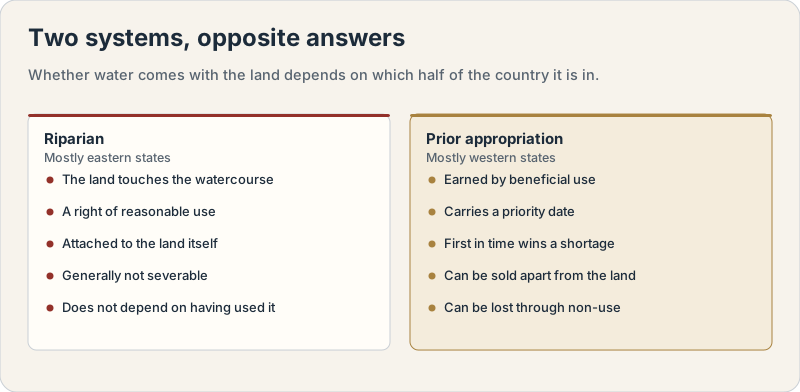
In the eastern states the rule is generally riparian. An owner whose land touches a watercourse has a right to make reasonable use of it, and that right belongs to the land rather than to a permit. It is not usually severable and it does not depend on having used the water.
West of roughly the hundredth meridian the rule is generally prior appropriation. A water right is earned by putting water to beneficial use, it carries a priority date, and the earliest date wins in a shortage. Critically, it is a property interest that can be sold separately from the land, which means a ranch can be conveyed with its water rights stripped out.
What the County Record Holds
Less than people expect, and more than nothing.
Deeds conveying or reserving water rights are recorded, and in appropriation states a reservation in an old deed is exactly how a property ends up with no water. Easements for ditches, headgates, pipelines and access to a point of diversion are recorded. Shared well agreements between neighboring parcels are recorded, or ought to be. Stock certificates in a mutual ditch or irrigation company are sometimes referenced in a deed, and the shares themselves are the water right in that structure.
What the recorder does not hold is the permit. In appropriation states the right itself is administered by a state engineer or water resources department, with its own file, its own priority date and its own record of whether the right has been used or abandoned.
Where the Rest of the Answer Lives
Three offices, none of them the recorder.
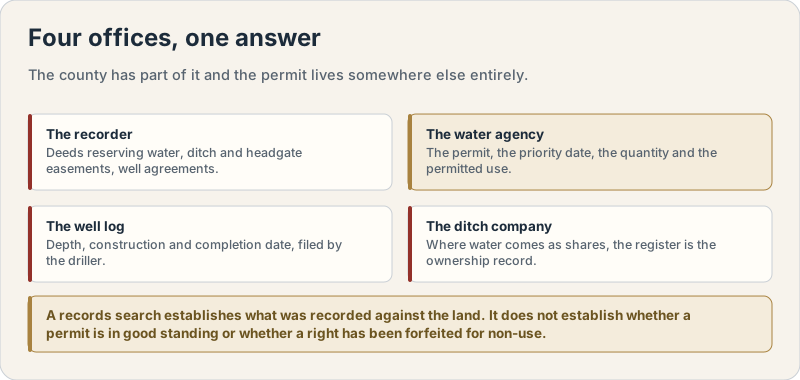
The state water agency holds the permit or certificate, the priority date, the permitted point of diversion, the quantity, and the beneficial use it was granted for. That file is the water right in any meaningful sense.
The well record, usually filed by the driller with a state agency, shows depth, construction, and the date the well was completed. On a domestic well this is frequently the only documentation that exists.
A ditch or irrigation company holds the share register where the water is delivered through a mutual company, and the shares transfer on that register rather than by deed.
A records search will establish what was recorded against the land. It will not tell you whether a permit is in good standing, whether a right has been forfeited for non-use, or how much water is actually available in a dry year.
What Goes Wrong
Five failures account for most of what turns up, and every one of them is findable before closing rather than after the first dry summer.
Irrigated recreational property is the clearest example, and our note on golf course and country club searches covers how a water right can be worth more than the ground it serves.
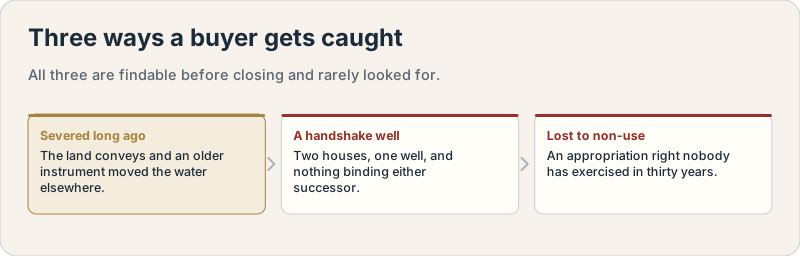
- A severed water right. The deed conveys the land and an earlier instrument moved the water elsewhere. The buyer owns irrigable acreage with nothing to irrigate it.
- A shared well with nothing recorded. Two houses on one well, an arrangement made by handshake decades ago, and no agreement binding either successor.
- An abandoned right. Appropriation rights can be lost through extended non-use, and a right nobody has exercised since 1994 may not survive scrutiny.
- A ditch easement nobody can find. The water arrives across three neighbors and the right to cross them was never papered.
- Assessments. Irrigation and conservancy districts levy on the parcel and can hold lien priority, which is the same mechanic as any assessment lien.
What to Order
Give us the address or parcel identifier, the state, and every name the property has been held in. Say whether the question is agricultural, whether a shared well is involved, and whether anybody has mentioned ditch company shares, because each changes the scope.
On appropriation-state property a chain of title search is usually the right order rather than a current owner search, since a severance reserving the water may be many decades old. Where the parcel is a working farm, the farm and ranch search covers this alongside the leases and crop liens.
Then take the parcel and the owner names to the state water agency, because that is where the right itself lives. A title search reports what was recorded and found in the indexes reviewed, as of the day the work was done. It is not a determination of water availability and it is not a legal opinion. See all search products, or tell us where the property is and we will scope it before anything is ordered. Commercial waterfront raises a related set of questions, covered in the marina and waterfront commercial search.
Order a certified title search today.
Certified abstractors, county-verified records, and clear turnaround times — nationwide.