TitleSearch.com Records
Marina Searches
On this page
Three Kinds of Ground in One Property
A marina is the clearest example in commercial real estate of a property whose parts answer to different owners and different offices.
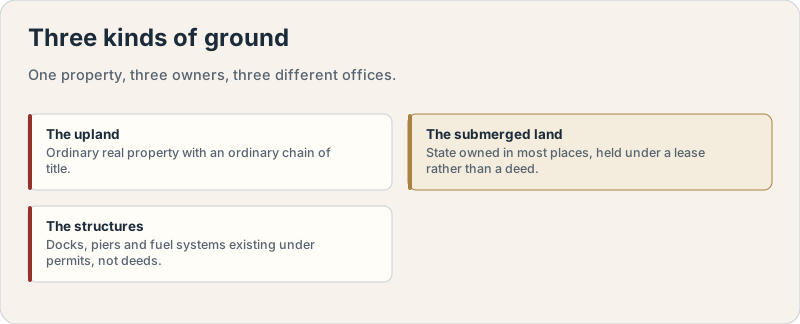
There is the upland, which is ordinary real property with an ordinary chain. There is the submerged land beneath the slips, which in most states belongs to the state and is held under a lease or an easement rather than owned. And there are the structures, meaning docks, piers, breakwaters and fuel systems, which exist under permits that are not recorded against the land at all.
A buyer who searches the upland and stops has searched the least valuable third of the property. Establishing where the private boundary stops is the first step, and on tidal water it is usually the mean high water mark rather than anything visible.
What the County Record Holds
A real and limited picture, and worth getting in full.
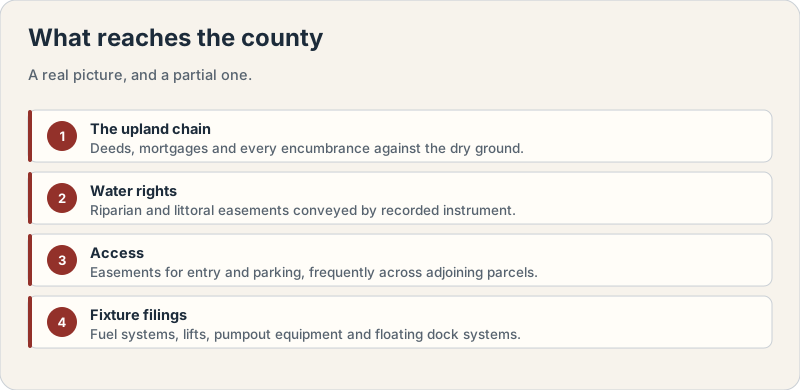
- The upland chain, with its deeds, mortgages and encumbrances.
- Riparian or littoral easements where water access rights were conveyed by recorded instrument.
- Recorded submerged land leases, where the state requires or permits recording, which varies considerably.
- Access and parking easements, which on a marina frequently cross adjoining parcels and are essential to operations.
- Slip assignment declarations where slips are sold as condominium units or as licensed rights.
- UCC fixture filings on fuel systems, lifts, pumpout equipment and floating dock systems.
Dockominium structures deserve particular attention, since a slip sold as a condominium unit is real property with its own chain, while a slip sold as a license is a contract right that may end when the marina changes hands.
What Sits With the Agencies
The permits, and they decide whether the marina can operate at the size it currently operates.
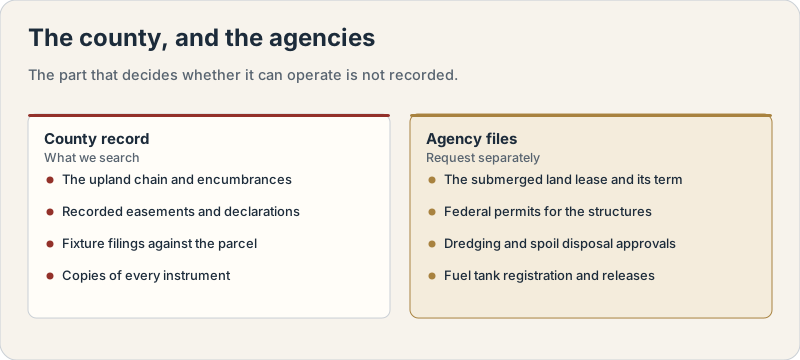
State submerged land leases carry terms, renewal conditions and rent that is frequently reset on transfer. Federal permits for work in navigable water govern the structures themselves. Environmental approvals cover dredging, which on a marina is a recurring operating cost rather than a one-time event, and the disposal of dredge spoil is a separate approval again.
Fuel operations bring their own layer. Underground and aboveground storage tank records, spill prevention plans and any release history sit with the state environmental agency, and on an older marina the tank history is worth as much attention as the chain of title.
None of that is recorded unless an environmental lien or a use limitation followed, so a clean county search is a statement about the record rather than about the site.
The Transfer Questions That Decide the Deal
Three of them, and all three are answered outside the recorder's office.
Does the submerged land lease transfer, and on what terms. Some require state approval, some reset the rent, and some have a remaining term shorter than the buyer's financing.
Do the permits transfer with the property or must they be reissued. A reissued permit can come with conditions the current one does not have.
Are the structures permitted as built. Docks get extended, reconfigured and rebuilt after storms, and the as-built configuration frequently does not match the permitted one.
Ordering the Search
Give us the address, the county, every parcel number in the upland, the marina name, and the ownership entity with any former names. Tell us whether slips are sold, leased or licensed, and whether the property includes a fuel dock, because both change what we look for.
A full chain of title search is the right scope here rather than a current owner search, since riparian grants and old easements are frequently decades old. A judgment and lien search against the operating entities belongs alongside it.
A title search reports what was recorded and found in the indexes reviewed, as of the day the work was done. It does not establish where the water boundary runs, which is a survey, and it does not report permit status or tank history. See all search products, or tell us the marina name and the county and we will scope it before anything is ordered.
Order a certified title search today.
Certified abstractors, county-verified records, and clear turnaround times — nationwide.