TitleSearch.com Records
Restaurant Searches
On this page
Most of the Value Is Not the Real Estate
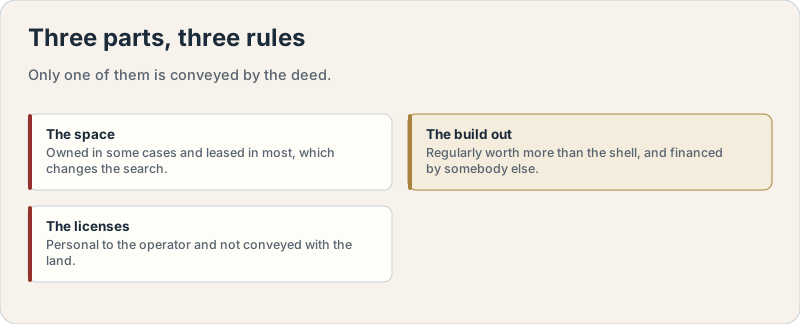
A restaurant sale bundles three things that behave differently. The space, which is frequently leased rather than owned. The build out, which can cost more than the shell containing it. And the licenses, which are personal to the operator and do not travel with the land.
Where the space is owned, the search is an ordinary commercial one with an unusual amount of equipment attached. Where it is leased, there is no real property to convey at all and the lease becomes the governing document.
Establishing which of the two you are looking at is the first question, and it changes everything that follows.
The Build Out and Who Financed It
This is the item most often missed and the one that most affects what a buyer actually receives.
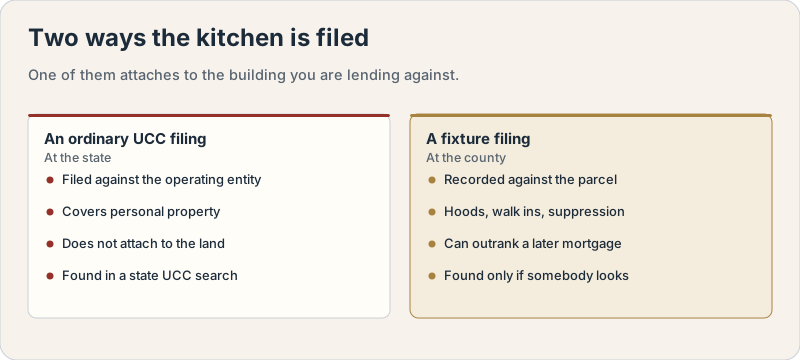
Hoods, fire suppression systems, make-up air, walk-in coolers and freezers, grease interceptors and the plumbing upgrades serving them are all affixed to the building. On a mid-sized restaurant the package regularly exceeds the value of the space, and a substantial share of it was financed by an equipment lender rather than by whoever holds the mortgage.
Where that financing was perfected by recording a fixture filing at the county rather than an ordinary UCC filing with the state, it attaches to the real property, and one recorded before a mortgage can take priority over it. Those filings are findable and a standard search will not necessarily look for them, so they should be requested by name. The mechanism is the same one covered in UCC fixture filings.
The Liquor License Is Separate Property
In most states a liquor license is personal property, it is issued to a person or an entity rather than to a location, and it can be pledged, sold or transferred independently of the real estate.
Several consequences follow. The license does not pass through a foreclosure of the building. It may already be subject to a security interest in favor of somebody other than the mortgage lender. In quota jurisdictions it may be worth a very large sum on its own. And transfer requires regulatory approval that is neither automatic nor quick.
A buyer acquiring a bar without confirming the license position has acquired a room with a long counter in it.
What Else the Record Carries
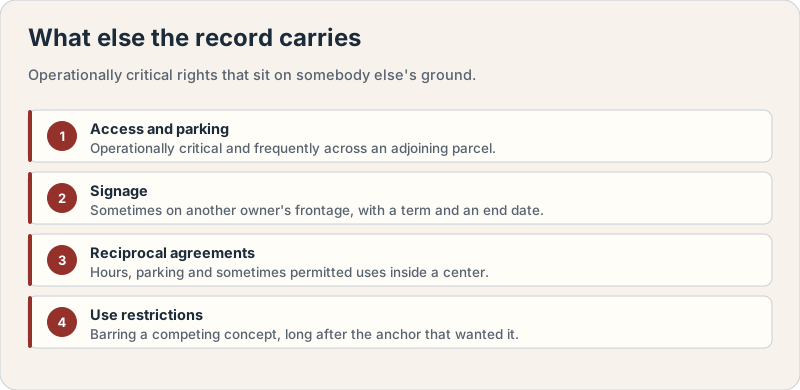
- Access and parking easements, which on a restaurant are operationally critical and frequently cross an adjoining parcel.
- Signage rights, sometimes on somebody else's frontage under a separate recorded easement with its own term.
- Reciprocal easement agreements where the restaurant sits inside a retail center, governing hours, parking and sometimes permitted uses.
- Use restrictions barring a competing concept, imposed for an anchor tenant and surviving long after that tenant has gone.
- Grease interceptor locations, occasionally shown on a recorded plat, more often not documented anywhere useful.
The use restriction is worth searching for specifically. A covenant recorded in 1994 barring a second pizza operation in a center can defeat a concept entirely, and it will not appear in any zoning review.
Ordering the Search
Give us the address, the county, the parcel number, the owning entity and the operating entity with every former name and any trade name used, and the landlord name where the space is leased. Say whether a liquor license is part of the transaction.
A full chain of title search with a judgment and lien search against each entity is the usual scope, and fixture filings should be requested explicitly.
A title search reports what was recorded and found in the indexes reviewed, as of the day the work was done. It does not report license status or transferability, health department history, lease terms, or what the business is worth. See all search products, or tell us the entity names and the county and we will scope it before anything is ordered.
Order a certified title search today.
Certified abstractors, county-verified records, and clear turnaround times — nationwide.