TitleSearch.com Records
Timeshare Searches
On this page
Deeded Interest or Right to Use
Before anything else, establish which kind of timeshare is in front of you, because the two are not variations on a theme and only one of them is real estate.
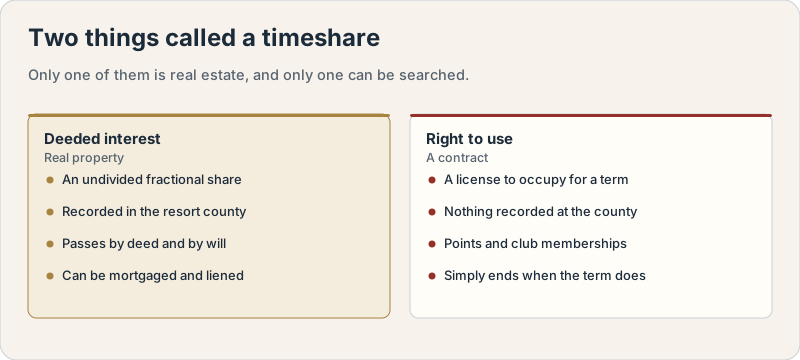
A deeded timeshare conveys an undivided fractional interest in a specific unit, recorded in the county where the resort sits. The owner appears in the grantee index, the interest passes by deed and by inheritance, and it can be mortgaged and liened like any other real property.
A right to use timeshare conveys a contractual license to occupy for a term of years. Nothing is recorded, the owner never appears in the land records, and when the term expires the right simply ends. Points-based and vacation club memberships usually fall here.
Most of what people want from a search is only available on the first kind. On the second, a county search will correctly return nothing at all, which is an accurate answer to a question the record cannot address.
What a Search Finds on a Deeded Week
Where the interest is deeded, the ordinary machinery applies and the ordinary machinery is useful.
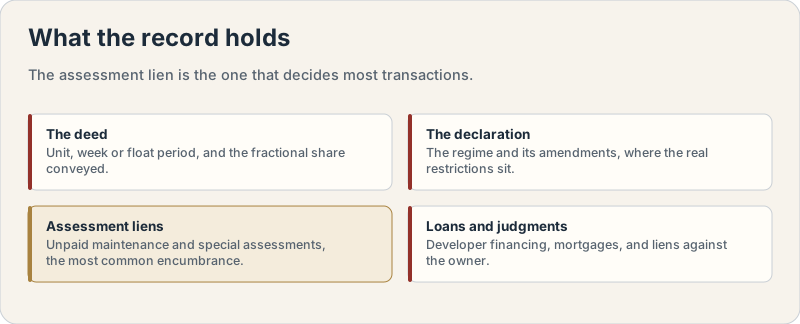
- The deed itself, identifying the unit, the week or the float period, and the fractional share conveyed.
- The declaration and its amendments, which govern the regime and are usually where the real restrictions live.
- Assessment liens recorded by the association for unpaid maintenance fees, which are by far the most common encumbrance on a timeshare.
- Mortgages, including developer financing that was never paid off.
- Judgment and tax liens against the owner that attach to the interest.
- Foreclosure filings, which move faster on timeshares than on most residential property.
The assessment picture is the one that surprises people. Maintenance fees continue whether or not the week is used, they escalate, and special assessments after a hurricane or a renovation can exceed the market value of the interest several times over. An owner who stopped paying in 2019 may have a lien balance larger than anything the week could sell for.
The Problems That Recur
A handful of patterns account for most of the trouble, and each of them is findable before money changes hands.
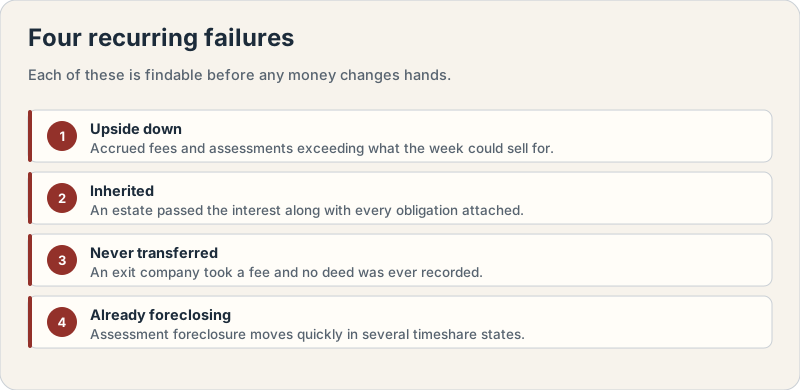
- The interest is worth less than what is owed. Secondary market prices for many resorts are near zero while accrued fees and assessments keep climbing.
- An inherited week nobody wanted. An estate passes the interest along with its obligations, and heirs frequently do not learn of it until a collection notice arrives.
- A transfer that never completed. Owners who paid an exit company often find the deed was never recorded and they remain the owner of record.
- An association foreclosure already underway. Non-judicial assessment foreclosure is available in several timeshare states and is quick.
- Old developer financing. A mortgage recorded in the 1980s and never released clouds the interest indefinitely.
A chain of title search is the version that establishes how the interest reached the current owner, which matters most where an estate or an exit company sits in the middle of the chain.
Ordering the Search
Give us the resort name and address, the county, the unit and week or interval number, and the owner's name as it appears on the deed or the billing statement. The interval designation matters, because a resort can hold several thousand separately deeded interests in the same building and indexing practice varies between counties.
What comes back is the recorded picture, which is the deed, the declaration, and every lien, mortgage and judgment found of record against that interest. What sits outside it is the association's internal ledger. The current fee balance, the assessment history and any pending special assessment come from the association rather than the recorder, and they are worth requesting in the same week.
Compare the options on our title search products page, or tell us the resort and the interval and we will tell you which search fits before anything is ordered. A related search on the ordinary residential side is the inherited property title search, which handles the estate pathway these interests so often travel.
Order a certified title search today.
Certified abstractors, county-verified records, and clear turnaround times — nationwide.