TitleSearch.com Records
Senior Housing Searches
On this page
Three Layers That Do Not Transfer Together
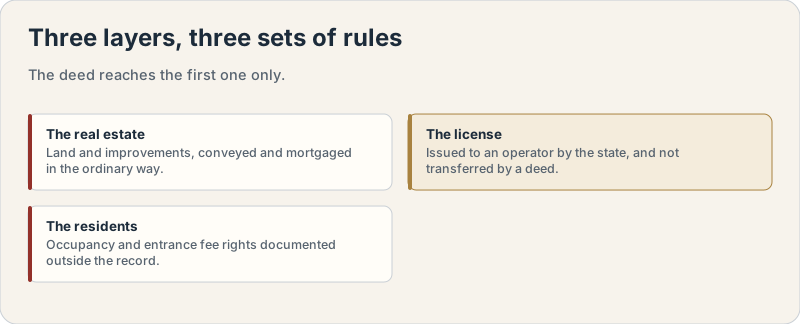
A senior housing transaction bundles a building, a license and a resident population, and they move by three different mechanisms. The real estate conveys by deed. The state license to operate a care facility runs to an operator and is transferred, if at all, through a regulatory process with its own timetable. The residents hold agreements that are documented almost entirely outside the land record.
A buyer who acquires the real estate has acquired a building that cannot lawfully be operated until the licensing piece is resolved separately. That is a familiar point in the sector and it still catches lenders who scope the title work as though this were an apartment building.
The search itself is an ordinary commercial search. What differs is what else has to be requested, and which recorded items turn out to matter.
How Residents Pay Changes the Analysis
This is the distinction that most affects a lender's position, and it is visible in the record only sometimes.
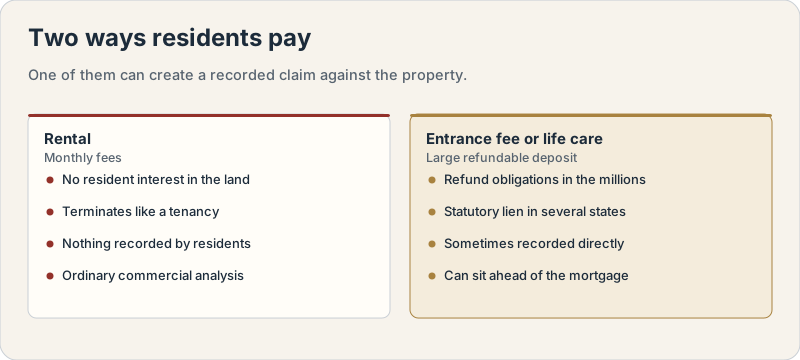
In a rental community, residents pay monthly and hold nothing resembling an interest in the property. The analysis is conventional.
In an entrance fee or continuing care community, residents pay a large deposit on moving in, frequently refundable in whole or in part. Across a full campus those refund obligations can reach into the tens of millions, and several states give residents a statutory lien on the property to secure them. In some jurisdictions that lien is recorded, in others it arises automatically and binds the property with nothing filed at all.
Where it exists, it can sit ahead of a mortgage. Establishing early which model the community runs, and what the state's statute does about resident claims, changes the whole shape of the credit.
The License Is Not Part of the Real Estate
State licensing for assisted living, skilled nursing and memory care is issued to an operator for a specific facility, and it does not pass with a deed.
Several consequences follow. A change of ownership generally requires regulatory notice and approval, and the timetable for that is set by the state rather than by the parties. A facility participating in federal programs carries provider agreements and an enrollment history, and successor liability for prior overpayments is a live issue in these deals. Enforcement history, survey findings and any admissions hold sit with the state agency and nowhere else.
None of this appears in a title search, and all of it belongs in diligence alongside one.
What the Record Does Carry
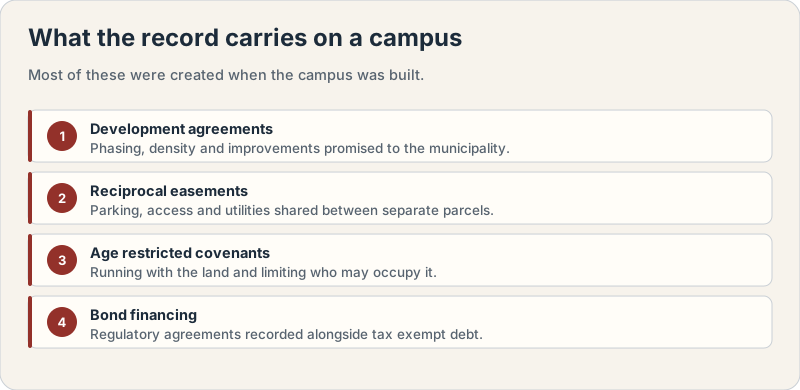
- Development agreements with the municipality, covering phasing, density and improvements the developer promised to build.
- Reciprocal easements for parking, access and utilities between buildings, because campuses are frequently several parcels rather than one.
- Age restricted covenants running with the land and limiting occupancy, which outlive whoever imposed them.
- Bond and agency financing documents, including regulatory agreements recorded alongside tax exempt debt, with their own restrictions and terms.
- Mechanics liens from the near constant renovation these properties undergo.
The parcel count is worth establishing first. A campus developed in phases over twenty years is commonly four or five parcels with agreements knitting them together, and a search scoped to the parcel the main building sits on will miss the parking field and the access drive.
Ordering the Search
Give us every parcel number with the county, the owning entity and the operating entity with all former names, and any affiliated nonprofit or system. Tell us whether the community charges entrance fees, because that changes what we look for.
A full chain of title search on each parcel with a judgment and lien search against every entity is the usual scope. Where the campus spans parcels, the approach in portfolio and bulk title search is usually the efficient way to run it.
A title search reports what was recorded and found in the indexes reviewed, as of the day the work was done. It does not report licensing status, survey history, resident agreements or census. See all search products, or tell us the parcels and the entity names and we will scope it before anything is ordered.
Order a certified title search today.
Certified abstractors, county-verified records, and clear turnaround times — nationwide.