TitleSearch.com Records
HELOC and Second Liens
On this page
Why a Junior Loan Needs Its Own Search
A home equity line or a second mortgage sits behind an existing first, and everything about the risk follows from that one fact. The lender is not buying the property. They are buying whatever value remains after every senior claim has been satisfied, and the size of that remainder is a question about other people's liens rather than about the borrower.
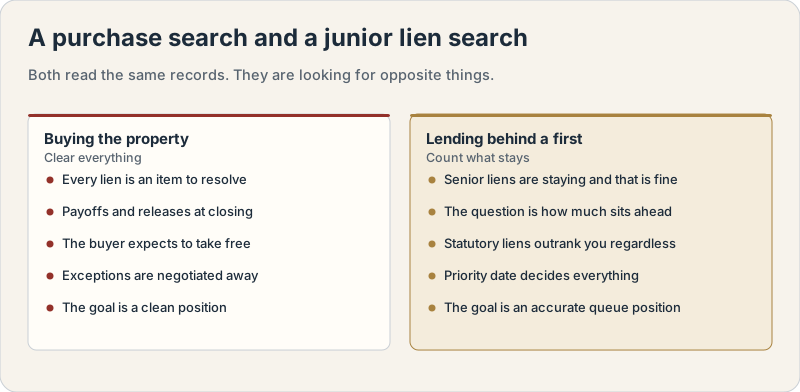
That makes the search a different exercise from a purchase search. On a purchase, the objective is to clear everything so the buyer takes free. On a junior loan, the objective is to establish exactly what will not be cleared, price it, and know where you stand in the queue.
What the Search Establishes
Four things, in order of how often they change the decision.
- The complete senior lien picture. Every mortgage and deed of trust of record, with recording dates and instrument numbers, plus any modification or consolidation agreement that changed the amount or the priority.
- The statutory liens. Property taxes, special assessments, municipal water and sewer charges and code enforcement claims. Most of these sit ahead of every private lien regardless of when they arose.
- Judgments and other involuntary liens indexed against the owner, which attach to the property by operation of law and may predate your recording.
- The vesting, which sounds routine and is not. A property held in a trust, held with a non-borrowing spouse, or held with a co-owner who is not signing changes who has to execute the security instrument.
The amount currently owed on the first is not a title question. A search establishes that the lien exists and what the recorded instrument says; the payoff figure comes from the servicer.
What Sits Ahead of You Without Looking Like It
Several categories routinely outrank a later-recorded junior lien and are easy to miss because they do not read as mortgages.
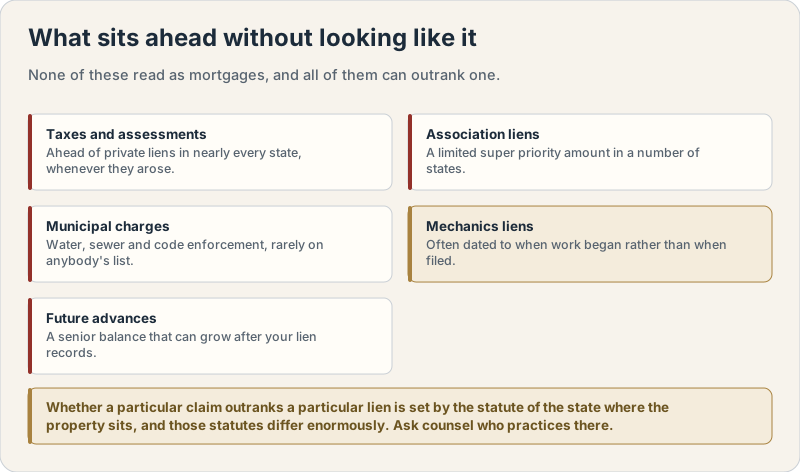
A homeowners association assessment lien can hold a super-priority position in a number of states, meaning a limited amount of unpaid assessments sits ahead of even a first mortgage. A special assessment district, the financing behind the roads and utilities in a newer subdivision, levies through the tax bill and generally carries tax lien priority. A mechanics lien in many states relates back to the date work began rather than the date it was filed, so work performed before your closing can produce a lien recorded afterward that outranks you.
And the first mortgage may not be the amount you think. A modification that capitalized arrears, or a future advance clause in the original instrument, can increase the senior balance after your lien records. Whether that advance retains its original priority is a question of state law and of the wording, and it is worth asking before closing rather than after.
Where a Junior Lien Gets Wiped Out
The structural risk in junior lending is that the position can disappear entirely without the debt going anywhere.
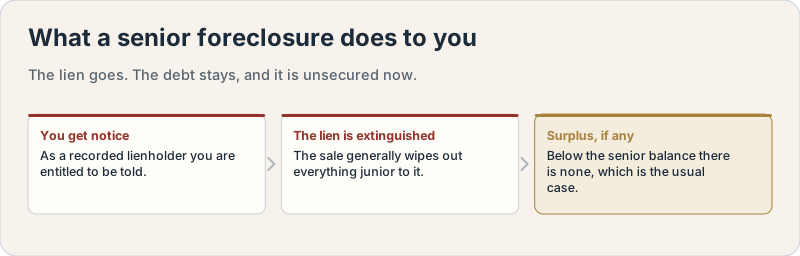
If the senior lender forecloses, the sale generally extinguishes every junior lien. The junior lienholder is entitled to notice and to any surplus proceeds, and where the property sells for less than the senior balance there is no surplus, which is the common case in a declining market. The debt survives as an unsecured obligation, which is a considerably worse asset.
A tax sale does the same thing more abruptly. A deed in lieu of foreclosure does the opposite and leaves junior liens in place, which is why a senior lender will not usually accept one where a second exists.
None of that is a reason to avoid junior lending. It is the reason the search has to be current rather than recent, since a notice of default recorded last month changes the whole analysis.
What to Order
Give us the address or the parcel identifier, the names of every owner of record including anyone not borrowing, and the state. Say that the order is for a junior lien, because it changes what we look for and how far back we run the name searches.
A current owner search with a judgment and lien search against every name is the usual scope. Where the chain has moved recently or the property came out of a foreclosure or an estate, a chain of title search is the better order. Where the borrower is an entity, the names to run are the entity's rather than the individual's.
A title search reports what was recorded and found in the indexes reviewed, as of the day the work was done. It is not a payoff statement, it is not a title insurance commitment and it is not a legal opinion about priority. See all search products, or tell us what you are lending against and we will scope it before anything is ordered.
Order a certified title search today.
Certified abstractors, county-verified records, and clear turnaround times — nationwide.