TitleSearch.com Records
Industrial Searches
On this page
The Site History Is the Search
On most commercial property the chain of title is a formality and the encumbrances are the work. On industrial property it runs the other way, because who used the site and for what is the question that decides everything else.
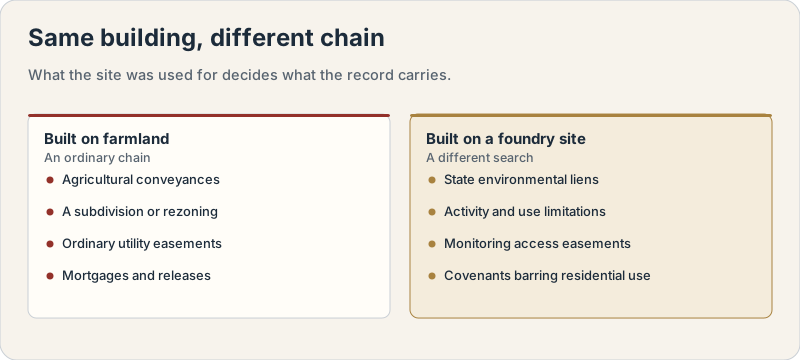
A warehouse built in 1998 on former farmland searches like any other building. The same warehouse built on a site that held a foundry until 1974 carries a different set of recorded instruments, a different lending conversation and a different price. The deed will not tell you which one you have. The chain will.
That makes a full chain of title search the usual scope here rather than a current owner search, and it makes the term worth extending rather than trimming.
What Industrial Parcels Carry
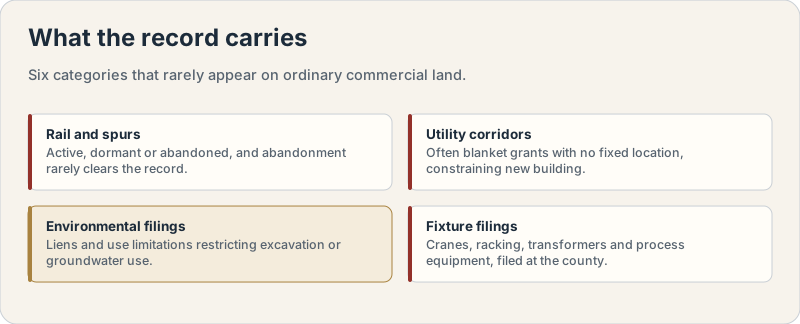
Six categories appear repeatedly and each can affect use or value.
- Rail easements and spur agreements. Active, dormant or long abandoned, and abandonment does not always clear the record. Reversionary rights in an old corridor can surface decades later.
- Utility and pipeline corridors. Often granted as blanket easements with no fixed location, which constrains where anything new can be built.
- Environmental liens and use limitations. Recorded by a state agency where public money funded an investigation or cleanup, frequently restricting excavation or groundwater use permanently.
- Access easements for monitoring. Rights granted to an agency or a prior owner to reach wells and remediation equipment on the site.
- UCC fixture filings. Cranes, racking, dock equipment, transformers and process equipment, filed at the county and with the state.
- Restrictive covenants from a prior sale. Barring competing uses or, on former industrial land, barring residential use entirely.
The environmental instruments are the ones buyers most often discover late, and they behave differently from other encumbrances. They run with the land, they survive a foreclosure, and paying something does not usually remove the recorded restriction.
What Sits With the Agencies Instead
A great deal, and the gap is wider on industrial property than on almost any other type.
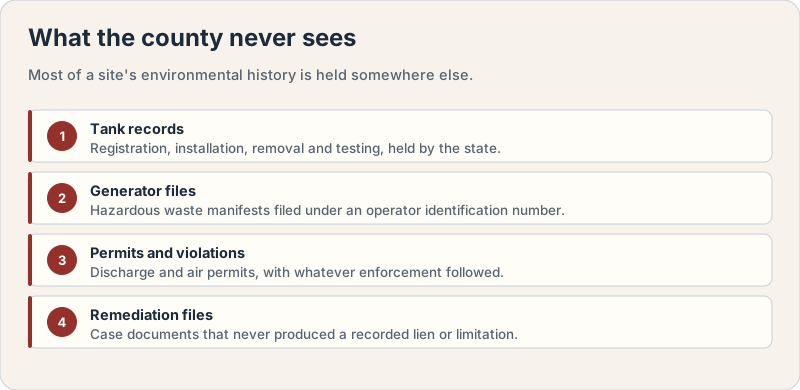
Underground storage tank records, hazardous waste generator files, discharge permits and violation history, air permits and remediation case files are all held by state and federal environmental agencies. None of it is recorded against the land unless a lien or a use limitation followed, and plenty of real contamination has never produced either.
The consequence is worth stating plainly. A clean county search on a former industrial site is a statement about the record, not about the soil. It is a necessary part of the diligence and it is not a substitute for an environmental site assessment, and no competent buyer treats it as one.
Zoning and Use Questions the Record Cannot Answer
Industrial zoning is frequently the reason a parcel is worth what it is, and it is not a title matter.
Whether a use is permitted, whether an existing operation is legally nonconforming, whether a special permit attaches to the land or to the operator, and whether the parcel can be redeveloped for a different use are all planning questions. So is whether outdoor storage, truck traffic or extended hours are allowed.
What the record does carry is any private restriction that narrows the zoning further. A covenant recorded in 1986 can forbid what the code permits, and the covenant wins between the parties bound by it.
Ordering the Search
Send us the address, the county, every parcel number in the site, and every owner and operator name across the period you want covered. Tell us what the site was used for historically if you know, and whether a rail spur ever served it, because both change the term and the scope.
A full chain search with a judgment and lien search against the ownership entities is the usual combination. Where a buyer is acquiring several buildings at once, a portfolio search priced as volume work makes more sense.
A title search reports what was recorded and found in the indexes reviewed, as of the day the work was done. It does not assess soil or groundwater, does not establish zoning compliance, and does not report what any agency file contains. See all search products, or tell us the address and the history and we will scope it before anything is ordered.
Order a certified title search today.
Certified abstractors, county-verified records, and clear turnaround times — nationwide.