TitleSearch.com Records
Parking Property Searches
On this page
Parking Is Usually Somebody Else's Right
A parking lot looks like the simplest real estate there is. Flat ground, a fence, a sign, and a cash flow. The complication is that the right to park on it, and the obligation to let other people park on it, are frequently recorded instruments that have nothing to do with the deed a buyer is about to receive.
Spaces get promised in reciprocal easement agreements, in leases, in condominium declarations and in zoning conditions, and each of those binds the land rather than the operator. A buyer who prices the income without reading them is pricing an assumption.
A Garage Can Be a Separate Estate
Structured parking introduces a question surface lots do not have. A garage attached to or beneath an office tower may be a separate legal parcel, a condominium unit under a recorded declaration, a leasehold estate, or an air rights parcel conveyed out of the tower decades ago.
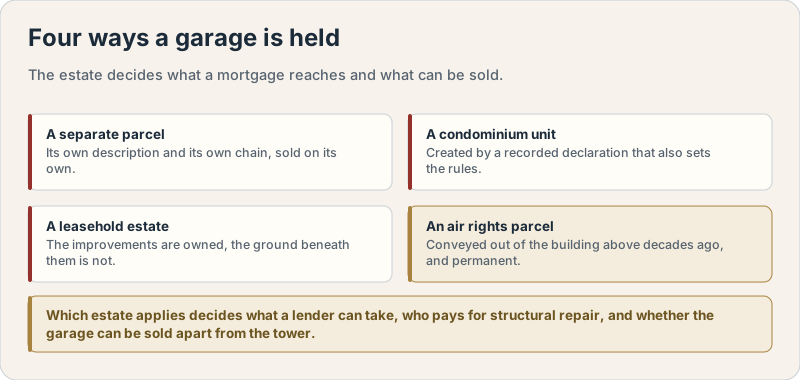
Which of those applies decides almost everything. It decides what a mortgage can reach, whether the garage can be sold independently, who pays for structural repair, and whether the tower's owner has a recorded right to a block of spaces that survives your purchase. Our note on condominium and HOA searches covers the declaration mechanics, and commercial property searches covers the parcel question more generally.
Vertical subdivisions are the hardest to read from the ground, because nothing visible tells you the second and third levels belong to a different owner than the first.
What Binds the Spaces
Several kinds of instrument allocate parking, and they behave differently.
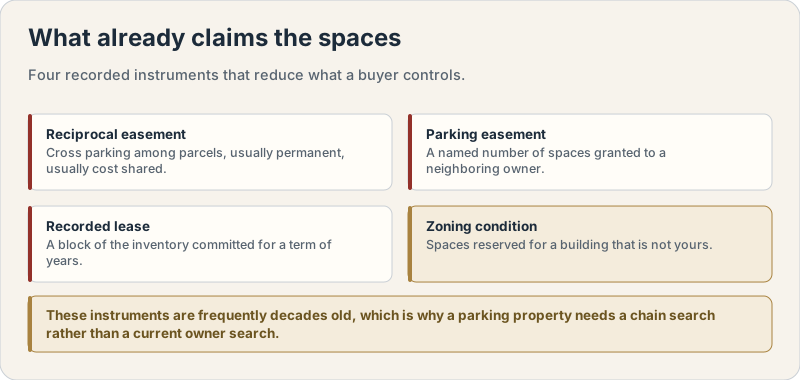
A reciprocal easement agreement in a shopping center or office park grants cross parking and access among the parcels, usually permanently, and usually with cost sharing attached. A parking easement may grant a named number of spaces to a neighboring owner. A recorded lease or memorandum of lease can commit a large block of the inventory for years. A zoning condition may require that a stated number of spaces be reserved for a building that is not yours, and where that condition was recorded against the land it runs with it.
None of these is unusual, and all of them reduce what a buyer actually controls. They are also the reason a parking search is a chain search rather than a current owner search, since the instruments are frequently decades old.
Ground Leases and Air Rights
A great many surface lots in dense markets sit on leased ground. The operator owns the improvements and the business and holds a leasehold interest in the land, which is a different asset from the fee. The remaining term, the renewal options and the reversion all matter more than the striping does, and a search of the recorded easements and rights of way is only half the picture when the estate itself is a lease.
Air rights move in the other direction. Where a developer sold the rights above a lot, the surface may be permanently limited to parking, which is good news for an operator and bad news for anyone pricing redevelopment.
Liens, Taxes and the Equipment
Parking properties carry the ordinary encumbrances of any commercial parcel, with a few that recur. Special assessment districts and parking benefit districts are common and are recorded against the land. Municipal liens for unpaid fees attach the same way. Where the lot is in a redevelopment area, a recorded development agreement may already commit the ground to something else.
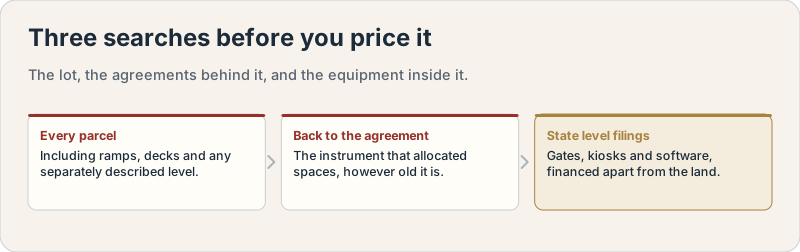
Access and revenue control equipment, gates, cameras, payment kiosks and the software behind them are personal property financed separately, and a financing statement filed at the state level will not appear in a search of the parcel. Where equipment is affixed, a fixture filing may be recorded in the county, and our note on UCC fixture filings explains how those read.
What a Search Settles, and What It Does Not
A title search reports what was recorded and found in the indexes reviewed over the term searched, in the county where the property sits. On a parking property that means the chain, the mortgages, the easements and reciprocal agreements, any recorded lease or memorandum, the recorded conditions and the liens, with copies attached.
It does not count your spaces, confirm that the striping matches the approved plan, tell you whether a zoning condition is still being enforced, or establish what the operating agreement obliges you to do. Those belong to a surveyor, to the planning office and to counsel.
Compare our search products, or tell us what you are buying and we will say which search fits before anything is ordered.
Order a certified title search today.
Certified abstractors, county-verified records, and clear turnaround times — nationwide.