TitleSearch.com Records
Fuel Site Searches
On this page
Why a Fuel Site Is Not an Ordinary Commercial Parcel
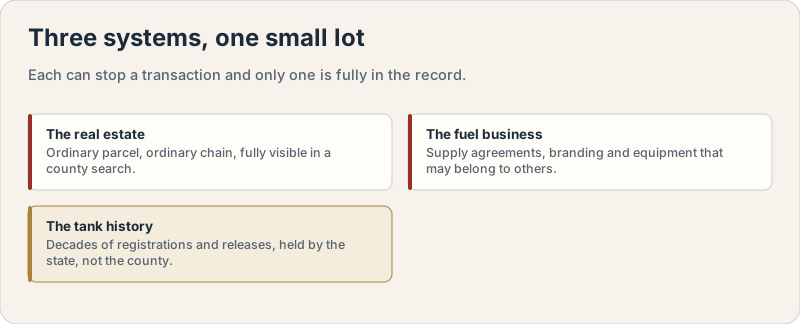
A gas station occupies a small lot and carries a diligence burden out of all proportion to its size, because three separate systems attach to it at once.
There is the real estate, which behaves normally. There is the fuel business, which comes with supply agreements, branding obligations and equipment that may belong to somebody else. And there is the regulatory history of the tanks, which reaches back decades and sits almost entirely outside the land record.
Any of the three can stop a transaction. Only the first is fully visible in a county search, and knowing which questions belong where is most of the work.
What the County Record Holds
A good deal, and it is worth pulling in full rather than in summary.
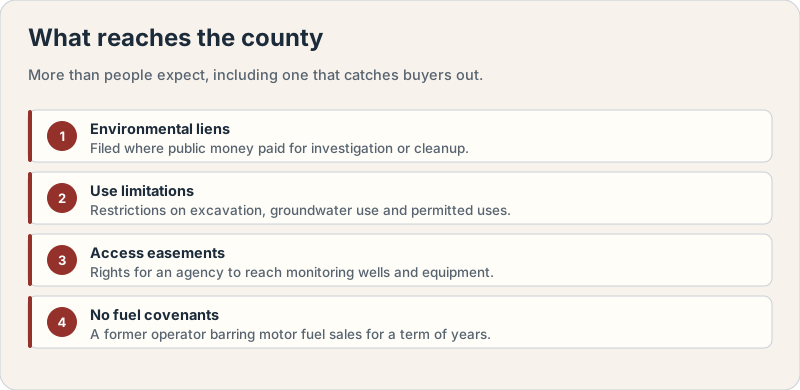
- Environmental liens filed by a state agency where public money paid for an investigation or a cleanup.
- Activity and use limitations and environmental covenants restricting excavation, groundwater use or the uses the site may be put to.
- Access easements granted to an agency or a responsible party for monitoring wells and remediation equipment.
- Recorded supply and branding agreements, which are sometimes filed as memoranda and sometimes not filed at all.
- Restrictive covenants against competing fuel use, frequently imposed when a former operator sold the site, and enforceable long after everyone involved has moved on.
- UCC fixture filings on dispensers, canopies, tanks and point of sale equipment.
That last competitive covenant is the one most often missed. A buyer planning to reopen a closed station can find the site recorded against selling motor fuel for another eleven years.
What Sits With the Agencies Instead
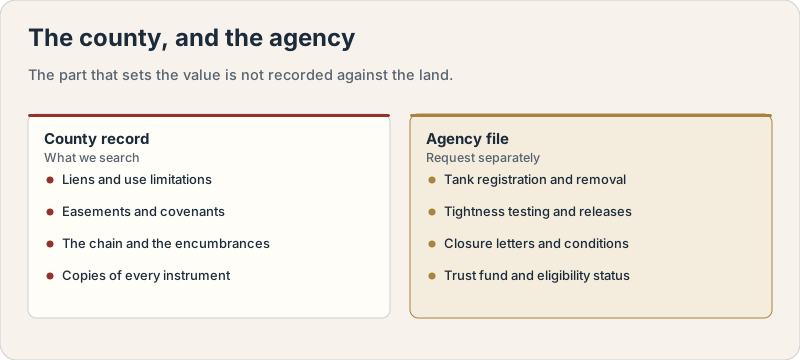
The tank history is a state and local record, not a county one, and it is the part that determines what the property is worth.
Underground storage tank registrations, installation and removal records, tightness testing, release reports and closure letters are held by the state environmental agency and sometimes by the local fire marshal. Financial responsibility filings and state trust fund claims are separate again. None of it is recorded against the land unless a lien or a use limitation followed.
The practical consequence is that a clean county search on a former fueling site proves very little about the site. It proves that nothing was recorded, which is a statement about the record rather than about the soil. A purchaser should order the county search and request the agency file in the same week, because the agency file takes longer to arrive.
The Recurring Problems
Four patterns account for most of the trouble on these transactions.
Tanks that were never properly closed. A site taken out of service in the 1990s may have tanks still in the ground with no closure documentation, which is both a liability and a lending obstacle.
A cleanup that was completed but never released of record. The state lien remains on the index long after the matter closed, and clearing it requires tracking down an agency file rather than a private lender.
Equipment that belongs to the fuel supplier. Dispensers, tanks and canopies are frequently supplier-owned under a long supply agreement, so the buyer of the real estate does not acquire the means of operating it.
Split ownership of the land and the business. A ground lease to the operator with the building owned separately is common, and the structure decides what a buyer is actually acquiring.
Ordering the Search
Send us the address, the county, the parcel number and every owner and operator name across the period you want covered, including the branded operator and any dealer entity. Tell us how far back the fueling use goes, if you know, because it sets the term.
A full chain of title search is the right scope here rather than a current owner search, since the instruments that matter are frequently decades old. A judgment and lien search against the operating entities belongs alongside it.
A title search reports what was recorded and found in the indexes reviewed, as of the day the work was done. It does not assess soil or groundwater, does not report tank status, and is not a substitute for an environmental site assessment. See all search products, or tell us the address and the history and we will scope it before anything is ordered. A site with a kitchen raises the same equipment questions in a different form, covered in the restaurant and bar search. A wash tunnel or a lube bay on the same lot raises them again, covered in the car wash and quick lube search.
Order a certified title search today.
Certified abstractors, county-verified records, and clear turnaround times — nationwide.