TitleSearch.com Records
Data Center Searches
On this page
The Land Is the Least Contested Part
A data center site is usually several hundred acres assembled out of farms, and the purchase price per acre is rarely what decides the deal. What decides it is whether electricity and fiber can physically reach the site, on a schedule anybody will commit to.
That splits the diligence in two. Part of it is a property question answered by a title search, because transmission corridors, substation parcels and fiber routes are recorded easements that run with the land. Part of it is a contract question the land record knows nothing about.
Confusing the two is the error that costs the most time, because a buyer can hold every easement the project needs and still have no date on which the site will be energized.
Two Different Things Called Power
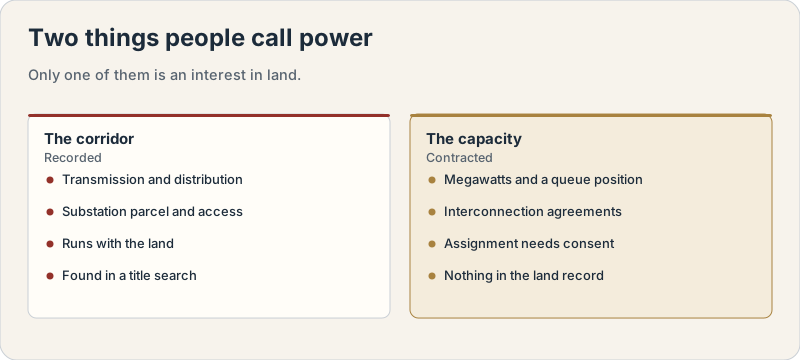
The corridor is a property right. A transmission or distribution easement, an access easement to a substation parcel, and sometimes a fee parcel conveyed to the utility outright. All of it is recorded, all of it is findable, and all of it binds successors.
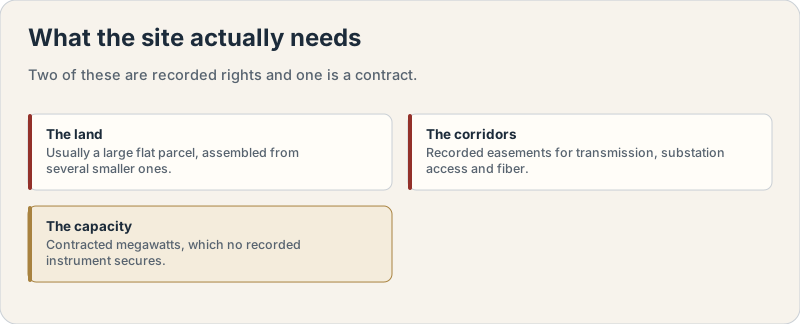
The capacity is a contract. Megawatts, a queue position, an interconnection agreement and a service date are commitments made by a utility to a customer, they are assignable only with consent, and nothing about them appears in the county record.
The same division runs through fiber. A recorded easement establishes that a conduit route exists across the land. Whether any carrier has lit capacity on it, and on what terms, is a question for the carrier.
Both halves are worth establishing early, and only one of them is something a title search can settle.
Assembled Sites Carry Assembled Histories
Because these parcels are put together from agricultural land, the search is several searches that have to reconcile with one another.
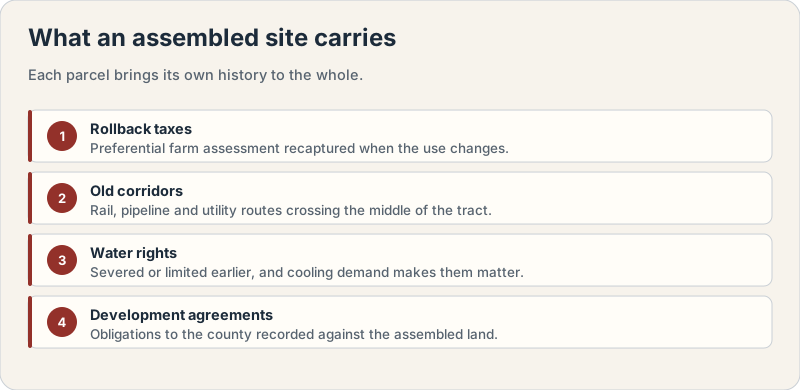
Rollback taxes are the first item. Land under a preferential agricultural assessment generally triggers a recapture of several years of deferred tax when the use changes, and on a large assemblage that figure is substantial and frequently overlooked until closing.
Old corridors are the second. Abandoned rail beds, pipelines, irrigation ditches and rural electric lines cross farmland constantly, and a route through the middle of the tract can determine where a building can physically sit. The analysis is the one in easement and right of way title search.
Water rights are the third, and they have become more consequential as cooling demand has grown. Where water was severed from the land earlier, or is subject to a district allocation, that affects what the site can do. The mechanics are those in water rights and well title search.
What Else the Record Carries
- Development agreements with the county, recording obligations about roads, water, noise and sometimes employment, which bind the land rather than the developer.
- Mineral reservations, which on former farmland are common and can carry surface access rights nobody wants under a building, as severed mineral rights describes.
- Setback and buffer covenants imposed at rezoning, frequently in favor of neighboring owners rather than the county.
- Fixture filings covering generators, switchgear and cooling plant, which attach to the real property and can outrank a later mortgage.
- Boundary gaps and overlaps between the assembled parcels, which is routine on old farm descriptions and best found before construction rather than during it.
The fixture filing point generalizes. On a built site the equipment inside is a very large share of the value, and some of it is financed separately from the real estate.
Ordering the Search
Give us every parcel number with the county, the owning entity and any assembly entity used to acquire the land, and the names of all prior owners where the parcels were bought individually. Tell us if a substation parcel or a corridor is part of the transaction.
A full chain of title search on each parcel is the usual scope, with a judgment and lien search against each entity, and fixture filings requested by name on a built site. Where the assemblage is large, portfolio and bulk title search is how it gets run efficiently.
A title search reports what was recorded and found in the indexes reviewed, as of the day the work was done. It does not report utility capacity, queue position, fiber availability or what any of it will cost. See all search products, or tell us the parcels and the county and we will scope it before anything is ordered.
Order a certified title search today.
Certified abstractors, county-verified records, and clear turnaround times — nationwide.